Digital marketing for estate agents: 8 effective strategies for growth
Best Practices & Trends
Published by
PriceHubble
-
16 Sept 2026

Digital marketing for estate agents: 8 effective strategies for growth
Best Practices & Trends
Published by
PriceHubble
-
16 Sept 2026
Digital marketing for estate agents: 8 effective strategies for growth
Best Practices & Trends
Published by
PriceHubble
-
16 Sept 2026
Picture two estate agencies in the same town. One puts a card in the window and hopes the phone rings. The other shows up in local search, is active on social media, and is starting to get mentioned when someone asks ChatGPT who's worth calling. In 2026, that gap between the two only gets wider.
Digital marketing for estate agents means using your website, local search visibility, social media, email and paid advertising, anchored in genuine hyper-local market data, to win instructions and generate qualified leads without depending on any single channel. The agencies picking up the most valuations right now combine strong local SEO, a visible social media presence and content built on real local data, and they're increasingly showing up in AI search answers as well as in Google.
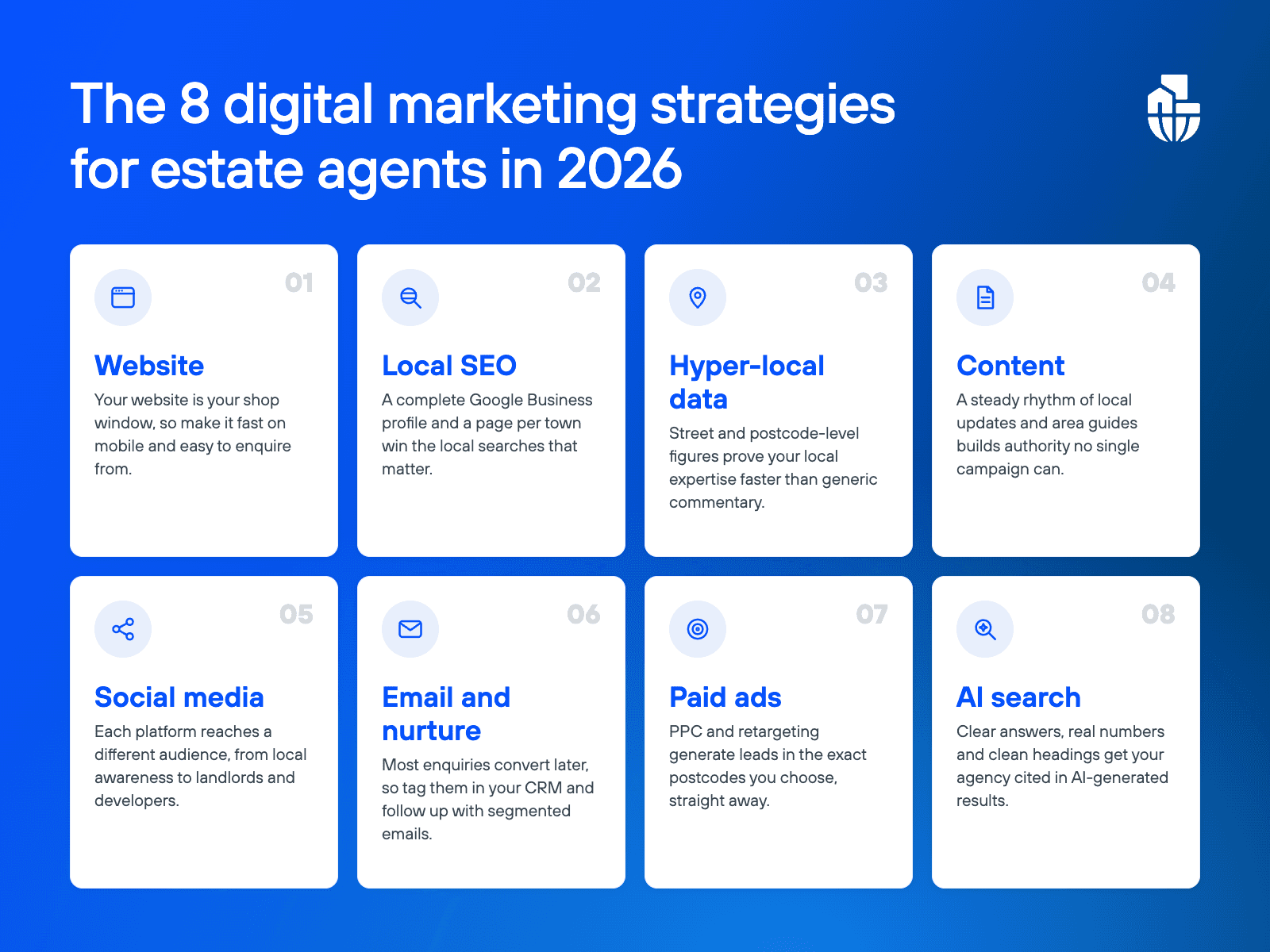
Your buyers and sellers are doing far more of their thinking before they ever pick up the phone to call you. By the time someone calls for a valuation, they've likely already checked your reviews, skimmed your website on their phone, and possibly asked an AI tool who's worth calling in your area. That's why a proper digital marketing strategy isn't optional for you in 2026, whatever the size of your agency. The eight strategies below give you the full picture: your website, search engine optimisation, hyper-local data, content, social media, email and CRM, paid advertising, and the newest frontier, AI search.
Picture two estate agencies in the same town. One puts a card in the window and hopes the phone rings. The other shows up in local search, is active on social media, and is starting to get mentioned when someone asks ChatGPT who's worth calling. In 2026, that gap between the two only gets wider.
Digital marketing for estate agents means using your website, local search visibility, social media, email and paid advertising, anchored in genuine hyper-local market data, to win instructions and generate qualified leads without depending on any single channel. The agencies picking up the most valuations right now combine strong local SEO, a visible social media presence and content built on real local data, and they're increasingly showing up in AI search answers as well as in Google.
Your buyers and sellers are doing far more of their thinking before they ever pick up the phone to call you. By the time someone calls for a valuation, they've likely already checked your reviews, skimmed your website on their phone, and possibly asked an AI tool who's worth calling in your area. That's why a proper digital marketing strategy isn't optional for you in 2026, whatever the size of your agency. The eight strategies below give you the full picture: your website, search engine optimisation, hyper-local data, content, social media, email and CRM, paid advertising, and the newest frontier, AI search.
Picture two estate agencies in the same town. One puts a card in the window and hopes the phone rings. The other shows up in local search, is active on social media, and is starting to get mentioned when someone asks ChatGPT who's worth calling. In 2026, that gap between the two only gets wider.
Digital marketing for estate agents means using your website, local search visibility, social media, email and paid advertising, anchored in genuine hyper-local market data, to win instructions and generate qualified leads without depending on any single channel. The agencies picking up the most valuations right now combine strong local SEO, a visible social media presence and content built on real local data, and they're increasingly showing up in AI search answers as well as in Google.
Your buyers and sellers are doing far more of their thinking before they ever pick up the phone to call you. By the time someone calls for a valuation, they've likely already checked your reviews, skimmed your website on their phone, and possibly asked an AI tool who's worth calling in your area. That's why a proper digital marketing strategy isn't optional for you in 2026, whatever the size of your agency. The eight strategies below give you the full picture: your website, search engine optimisation, hyper-local data, content, social media, email and CRM, paid advertising, and the newest frontier, AI search.
In short: Key takeaways for a successful digital marketing strategy
Website: your estate agency website is your shop window; slow or generic sites lose instructions before the phone ever rings.
Local SEO and GEO: most property searches are hyper-local, so a claimed, active Google Business profile and location-related SEO/GEO pages matter more than national rankings.
Hyper-local data: publishing genuine street and postcode-level market data builds authority faster than generic advice ever will.
Content marketing: consistent, locally specific content turns your website and channels into a source people return to, not a one-off landing page.
Social media: different platforms serve different audiences and purposes, from local awareness to landlord and investor relationships.
Email and nurture marketing: most enquiries don't convert on the first contact; a proper nurture sequence is what turns them into instructions.
PPC and retargeting: paid search and Facebook ads let you generate leads on your own terms, in the postcodes you choose.
AI search: buyers and sellers are starting to ask ChatGPT and AI Overviews for local agent recommendations directly, you need to make sure you understand how to optimise your content accordingly.
In short: Key takeaways for a successful digital marketing strategy
Website: your estate agency website is your shop window; slow or generic sites lose instructions before the phone ever rings.
Local SEO and GEO: most property searches are hyper-local, so a claimed, active Google Business profile and location-related SEO/GEO pages matter more than national rankings.
Hyper-local data: publishing genuine street and postcode-level market data builds authority faster than generic advice ever will.
Content marketing: consistent, locally specific content turns your website and channels into a source people return to, not a one-off landing page.
Social media: different platforms serve different audiences and purposes, from local awareness to landlord and investor relationships.
Email and nurture marketing: most enquiries don't convert on the first contact; a proper nurture sequence is what turns them into instructions.
PPC and retargeting: paid search and Facebook ads let you generate leads on your own terms, in the postcodes you choose.
AI search: buyers and sellers are starting to ask ChatGPT and AI Overviews for local agent recommendations directly, you need to make sure you understand how to optimise your content accordingly.
In short: Key takeaways for a successful digital marketing strategy
Website: your estate agency website is your shop window; slow or generic sites lose instructions before the phone ever rings.
Local SEO and GEO: most property searches are hyper-local, so a claimed, active Google Business profile and location-related SEO/GEO pages matter more than national rankings.
Hyper-local data: publishing genuine street and postcode-level market data builds authority faster than generic advice ever will.
Content marketing: consistent, locally specific content turns your website and channels into a source people return to, not a one-off landing page.
Social media: different platforms serve different audiences and purposes, from local awareness to landlord and investor relationships.
Email and nurture marketing: most enquiries don't convert on the first contact; a proper nurture sequence is what turns them into instructions.
PPC and retargeting: paid search and Facebook ads let you generate leads on your own terms, in the postcodes you choose.
AI search: buyers and sellers are starting to ask ChatGPT and AI Overviews for local agent recommendations directly, you need to make sure you understand how to optimise your content accordingly.
1. Build a website that works as your shop window
Your estate agent website is usually the first proper impression a seller, landlord or buyer forms of your agency, and it's doing that job whether you've invested in it or not. A slow, generic estate agency website quietly loses instructions long before a valuation is ever booked, because visitors simply leave for a competitor's site.
Why it matters: website design and web design decisions directly affect conversion rates. A visitor who can't find a valuation form in ten seconds, or who waits more than a couple of seconds for a page to load on their phone, rarely comes back.
Resource investment: Medium, mostly upfront, then light ongoing maintenance.
Good landing pages, one per town or development you actively work in, do more for your online presence than a single "contact us" page ever will. Each one gives search engines, and increasingly AI search tools, a clear, specific page to point people towards.
1. Build a website that works as your shop window
Your estate agent website is usually the first proper impression a seller, landlord or buyer forms of your agency, and it's doing that job whether you've invested in it or not. A slow, generic estate agency website quietly loses instructions long before a valuation is ever booked, because visitors simply leave for a competitor's site.
Why it matters: website design and web design decisions directly affect conversion rates. A visitor who can't find a valuation form in ten seconds, or who waits more than a couple of seconds for a page to load on their phone, rarely comes back.
Resource investment: Medium, mostly upfront, then light ongoing maintenance.
Good landing pages, one per town or development you actively work in, do more for your online presence than a single "contact us" page ever will. Each one gives search engines, and increasingly AI search tools, a clear, specific page to point people towards.
1. Build a website that works as your shop window
Your estate agent website is usually the first proper impression a seller, landlord or buyer forms of your agency, and it's doing that job whether you've invested in it or not. A slow, generic estate agency website quietly loses instructions long before a valuation is ever booked, because visitors simply leave for a competitor's site.
Why it matters: website design and web design decisions directly affect conversion rates. A visitor who can't find a valuation form in ten seconds, or who waits more than a couple of seconds for a page to load on their phone, rarely comes back.
Resource investment: Medium, mostly upfront, then light ongoing maintenance.
Good landing pages, one per town or development you actively work in, do more for your online presence than a single "contact us" page ever will. Each one gives search engines, and increasingly AI search tools, a clear, specific page to point people towards.
Five-point website audit
Does the site load in under three seconds on mobile?
Is the "get a valuation" or "book a viewing" call to action visible without scrolling?
Do you have dedicated landing pages for the towns or postcodes you cover, rather than one generic "areas we cover" page?
Are trust signals (reviews, years trading, professional body membership) visible on the homepage?
Is there a clear, single call to action per page, rather than five competing ones?
Five-point website audit
Does the site load in under three seconds on mobile?
Is the "get a valuation" or "book a viewing" call to action visible without scrolling?
Do you have dedicated landing pages for the towns or postcodes you cover, rather than one generic "areas we cover" page?
Are trust signals (reviews, years trading, professional body membership) visible on the homepage?
Is there a clear, single call to action per page, rather than five competing ones?
Five-point website audit
Does the site load in under three seconds on mobile?
Is the "get a valuation" or "book a viewing" call to action visible without scrolling?
Do you have dedicated landing pages for the towns or postcodes you cover, rather than one generic "areas we cover" page?
Are trust signals (reviews, years trading, professional body membership) visible on the homepage?
Is there a clear, single call to action per page, rather than five competing ones?
2. Win local SEO and search, not just national rankings
Search engine optimisation for an estate agency isn't only about ranking for "buy a house"; it's about ranking for google searches like "estate agents in [your town]" and the dozens of local search variants sellers and landlords actually type. That's local SEO, and it rewards specificity over scale.
Why it matters: most property searches are hyper-local by definition. Ranking first for a single town beats ranking fortieth nationally, every time, because that's where your actual clients are searching.
Resource investment: Medium to high, and ongoing rather than one-off.
Local SEO and local search quick wins
Claim and fully complete your Google Business profile, including opening hours, service areas and photos of your team and office.
Ask happy clients for Google reviews after every completed sale or letting, not just occasionally.
Build dedicated local search landing pages on your website for each area you cover.
Add local business schema markup so search engines and AI tools can read your address, opening hours and service area correctly.
Reviews matter more than most agencies assume. BrightLocal's 2026 Local Consumer Review Survey found that 97 per cent of consumers read reviews for local businesses, and 41 per cent say they always do before making a decision, up sharply from 29 per cent the year before. Just under half, 49 per cent, now trust online reviews as much as a personal recommendation. A Google Business profile with a thin or empty review section is a genuine handicap against a competitor with fifty recent, genuine reviews attached to theirs.
3. Use hyper-local market data to build authority and online visibility
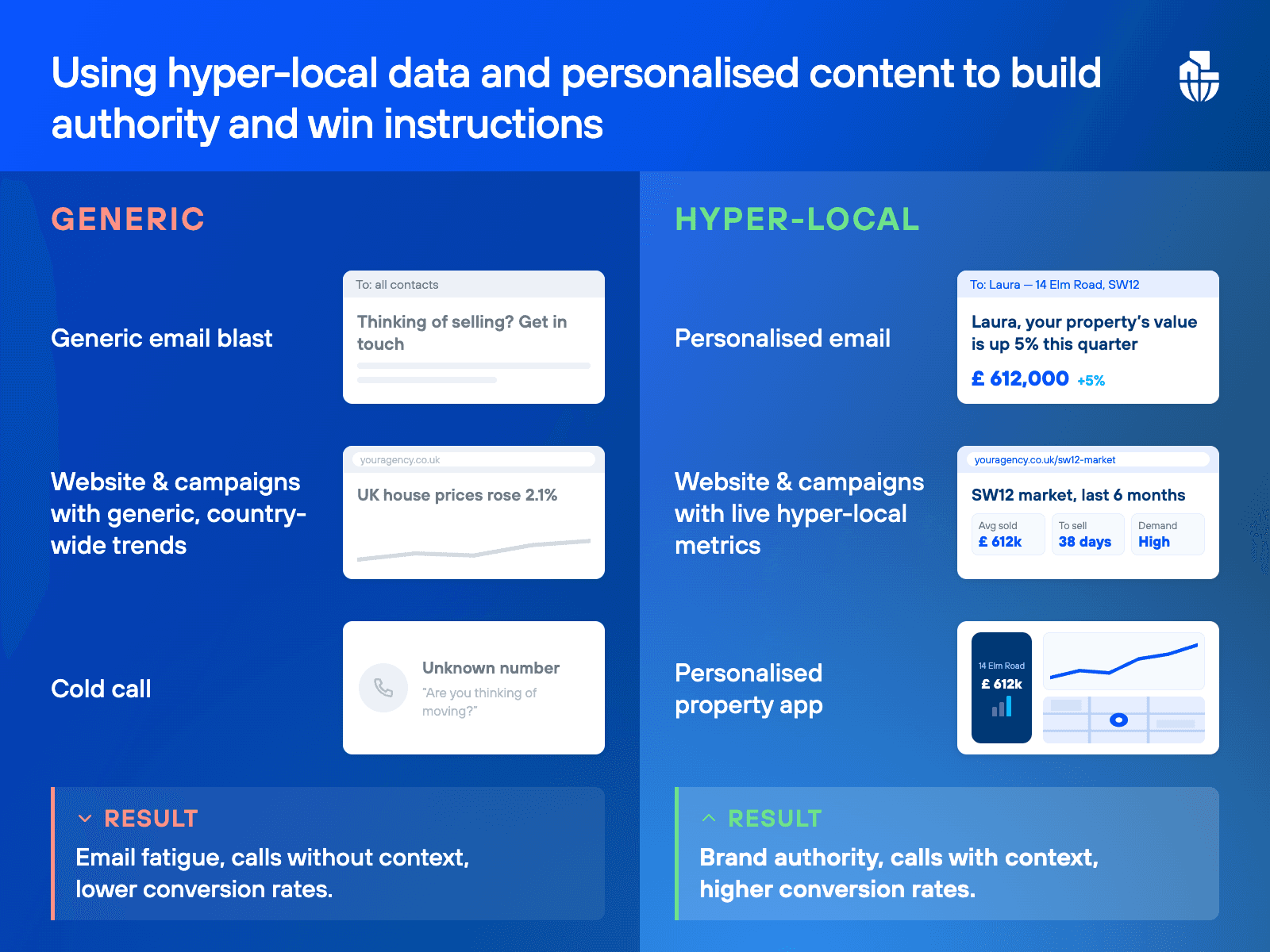
This is the strategy that sets data-led estate agents apart from the rest, and it works for two reasons at once. First, sellers and landlords choosing who to instruct are drawn to estate agents who can show them something specific and credible about their own street, not a generic "prices are rising" comment. Second, that same specificity is exactly what search engines and AI search tools reward: precise, sourced, numerical content outperforms vague marketing copy on both counts.
Why it matters: HSBC's Beyond the Bricks study is still one of the most-cited pieces of research on this shift, even though it's a few years old. The study found that 93 per cent of UK home buyers used online channels to research their most recent property purchase, ahead of the 89 per cent global average, and that 59 per cent either made their first approach to an estate agency online or split it evenly between online and offline.
Resource investment: Low to medium, particularly if you already have access to granular local data.
What "hyper-local" actually means:
Town-level data: "Average prices in [town] rose 4% this year." Useful, but so generic it could belong to any agency's newsletter.
Postcode or street-level data: "Three-bedroom semis on [street name] have sold for an average of X in the past six months, against Y a year ago." Specific, verifiable, and something only an agency with genuine local access can say.
This is where Dataloft by PriceHubble earns its keep for agencies that use it: postcode-level pricing, rental and demand data that turns a generic market update into a piece of content that's genuinely useful, and genuinely yours. Publishing that kind of detail consistently, rather than once a quarter, is what builds brand awareness and brand visibility that outlasts any single campaign.
4. Turn content marketing into an authority habit
Content marketing for estate agents works when it's treated as a habit rather than a one-off project. A single blog post rarely moves the needle; a steady stream of genuinely local, useful content does, because it gives people a reason to keep coming back to your estate agent website between moves. Again, integrating hyper-local data in your content marketing activities and strategy is a winning tactic here.
Why it matters: agencies that publish real local insight get referenced, shared and linked to, rather than competing purely on the strength of their listings. That's a meaningful part of any digital marketing strategy aimed at long-term brand awareness rather than a single campaign spike.
Resource investment: Medium, and most effective as an ongoing commitment rather than a burst of activity.
A simple content marketing rhythm to start with:
Monthly: a local market update, using your own hyper-local data.
Quarterly: a guide for a specific audience (first-time buyers, landlords, downsizers).
As needed: an area guide for each of your core postcodes.
Ongoing: short updates whenever local news (new transport links, planning approvals, school ratings) affects prices.
Important: Keep each piece focused on one clear idea. A market update that also tries to be a first-time buyer guide and a landlord newsletter ends up serving none of those readers particularly well.
5. Social media channels: Meet buyers, sellers and landlords where they scroll
Social media earns its place in a digital marketing strategy because different platforms genuinely serve different parts of your audience and different age groups, not because every agency needs to be active everywhere at once. Facebook and Instagram tend to work best for local awareness and new listings, LinkedIn for landlords, developers and other professional relationships, and TikTok and YouTube for reaching people well before they've even started thinking about instructing an agent.
Why it matters: Social media platforms are often where a seller first notices your agency exists, well before they search for you directly. The National Association of Realtors' Member Technology Survey found that 63 per cent of agents use social media to advertise listings, and 46 per cent rank it as their single greatest source of high-quality leads. That's US data rather than UK-specific, but the direction of travel matches what's happening across the property sector here too.
Resource investment: Medium, split between organic posting and paid promotion.
2. Win local SEO and search, not just national rankings
Search engine optimisation for an estate agency isn't only about ranking for "buy a house"; it's about ranking for google searches like "estate agents in [your town]" and the dozens of local search variants sellers and landlords actually type. That's local SEO, and it rewards specificity over scale.
Why it matters: most property searches are hyper-local by definition. Ranking first for a single town beats ranking fortieth nationally, every time, because that's where your actual clients are searching.
Resource investment: Medium to high, and ongoing rather than one-off.
Local SEO and local search quick wins
Claim and fully complete your Google Business profile, including opening hours, service areas and photos of your team and office.
Ask happy clients for Google reviews after every completed sale or letting, not just occasionally.
Build dedicated local search landing pages on your website for each area you cover.
Add local business schema markup so search engines and AI tools can read your address, opening hours and service area correctly.
Reviews matter more than most agencies assume. BrightLocal's 2026 Local Consumer Review Survey found that 97 per cent of consumers read reviews for local businesses, and 41 per cent say they always do before making a decision, up sharply from 29 per cent the year before. Just under half, 49 per cent, now trust online reviews as much as a personal recommendation. A Google Business profile with a thin or empty review section is a genuine handicap against a competitor with fifty recent, genuine reviews attached to theirs.
3. Use hyper-local market data to build authority and online visibility
This is the strategy that sets data-led estate agents apart from the rest, and it works for two reasons at once. First, sellers and landlords choosing who to instruct are drawn to estate agents who can show them something specific and credible about their own street, not a generic "prices are rising" comment. Second, that same specificity is exactly what search engines and AI search tools reward: precise, sourced, numerical content outperforms vague marketing copy on both counts.
Why it matters: HSBC's Beyond the Bricks study is still one of the most-cited pieces of research on this shift, even though it's a few years old. The study found that 93 per cent of UK home buyers used online channels to research their most recent property purchase, ahead of the 89 per cent global average, and that 59 per cent either made their first approach to an estate agency online or split it evenly between online and offline.
Resource investment: Low to medium, particularly if you already have access to granular local data.
What "hyper-local" actually means:
Town-level data: "Average prices in [town] rose 4% this year." Useful, but so generic it could belong to any agency's newsletter.
Postcode or street-level data: "Three-bedroom semis on [street name] have sold for an average of X in the past six months, against Y a year ago." Specific, verifiable, and something only an agency with genuine local access can say.
This is where Dataloft by PriceHubble earns its keep for agencies that use it: postcode-level pricing, rental and demand data that turns a generic market update into a piece of content that's genuinely useful, and genuinely yours. Publishing that kind of detail consistently, rather than once a quarter, is what builds brand awareness and brand visibility that outlasts any single campaign.
4. Turn content marketing into an authority habit
Content marketing for estate agents works when it's treated as a habit rather than a one-off project. A single blog post rarely moves the needle; a steady stream of genuinely local, useful content does, because it gives people a reason to keep coming back to your estate agent website between moves. Again, integrating hyper-local data in your content marketing activities and strategy is a winning tactic here.
Why it matters: agencies that publish real local insight get referenced, shared and linked to, rather than competing purely on the strength of their listings. That's a meaningful part of any digital marketing strategy aimed at long-term brand awareness rather than a single campaign spike.
Resource investment: Medium, and most effective as an ongoing commitment rather than a burst of activity.
A simple content marketing rhythm to start with:
Monthly: a local market update, using your own hyper-local data.
Quarterly: a guide for a specific audience (first-time buyers, landlords, downsizers).
As needed: an area guide for each of your core postcodes.
Ongoing: short updates whenever local news (new transport links, planning approvals, school ratings) affects prices.
Important: Keep each piece focused on one clear idea. A market update that also tries to be a first-time buyer guide and a landlord newsletter ends up serving none of those readers particularly well.
5. Social media channels: Meet buyers, sellers and landlords where they scroll
Social media earns its place in a digital marketing strategy because different platforms genuinely serve different parts of your audience and different age groups, not because every agency needs to be active everywhere at once. Facebook and Instagram tend to work best for local awareness and new listings, LinkedIn for landlords, developers and other professional relationships, and TikTok and YouTube for reaching people well before they've even started thinking about instructing an agent.
Why it matters: Social media platforms are often where a seller first notices your agency exists, well before they search for you directly. The National Association of Realtors' Member Technology Survey found that 63 per cent of agents use social media to advertise listings, and 46 per cent rank it as their single greatest source of high-quality leads. That's US data rather than UK-specific, but the direction of travel matches what's happening across the property sector here too.
Resource investment: Medium, split between organic posting and paid promotion.
2. Win local SEO and search, not just national rankings
Search engine optimisation for an estate agency isn't only about ranking for "buy a house"; it's about ranking for google searches like "estate agents in [your town]" and the dozens of local search variants sellers and landlords actually type. That's local SEO, and it rewards specificity over scale.
Why it matters: most property searches are hyper-local by definition. Ranking first for a single town beats ranking fortieth nationally, every time, because that's where your actual clients are searching.
Resource investment: Medium to high, and ongoing rather than one-off.
Local SEO and local search quick wins
Claim and fully complete your Google Business profile, including opening hours, service areas and photos of your team and office.
Ask happy clients for Google reviews after every completed sale or letting, not just occasionally.
Build dedicated local search landing pages on your website for each area you cover.
Add local business schema markup so search engines and AI tools can read your address, opening hours and service area correctly.
Reviews matter more than most agencies assume. BrightLocal's 2026 Local Consumer Review Survey found that 97 per cent of consumers read reviews for local businesses, and 41 per cent say they always do before making a decision, up sharply from 29 per cent the year before. Just under half, 49 per cent, now trust online reviews as much as a personal recommendation. A Google Business profile with a thin or empty review section is a genuine handicap against a competitor with fifty recent, genuine reviews attached to theirs.
3. Use hyper-local market data to build authority and online visibility
This is the strategy that sets data-led estate agents apart from the rest, and it works for two reasons at once. First, sellers and landlords choosing who to instruct are drawn to estate agents who can show them something specific and credible about their own street, not a generic "prices are rising" comment. Second, that same specificity is exactly what search engines and AI search tools reward: precise, sourced, numerical content outperforms vague marketing copy on both counts.
Why it matters: HSBC's Beyond the Bricks study is still one of the most-cited pieces of research on this shift, even though it's a few years old. The study found that 93 per cent of UK home buyers used online channels to research their most recent property purchase, ahead of the 89 per cent global average, and that 59 per cent either made their first approach to an estate agency online or split it evenly between online and offline.
Resource investment: Low to medium, particularly if you already have access to granular local data.
What "hyper-local" actually means:
Town-level data: "Average prices in [town] rose 4% this year." Useful, but so generic it could belong to any agency's newsletter.
Postcode or street-level data: "Three-bedroom semis on [street name] have sold for an average of X in the past six months, against Y a year ago." Specific, verifiable, and something only an agency with genuine local access can say.
This is where Dataloft by PriceHubble earns its keep for agencies that use it: postcode-level pricing, rental and demand data that turns a generic market update into a piece of content that's genuinely useful, and genuinely yours. Publishing that kind of detail consistently, rather than once a quarter, is what builds brand awareness and brand visibility that outlasts any single campaign.
4. Turn content marketing into an authority habit
Content marketing for estate agents works when it's treated as a habit rather than a one-off project. A single blog post rarely moves the needle; a steady stream of genuinely local, useful content does, because it gives people a reason to keep coming back to your estate agent website between moves. Again, integrating hyper-local data in your content marketing activities and strategy is a winning tactic here.
Why it matters: agencies that publish real local insight get referenced, shared and linked to, rather than competing purely on the strength of their listings. That's a meaningful part of any digital marketing strategy aimed at long-term brand awareness rather than a single campaign spike.
Resource investment: Medium, and most effective as an ongoing commitment rather than a burst of activity.
A simple content marketing rhythm to start with:
Monthly: a local market update, using your own hyper-local data.
Quarterly: a guide for a specific audience (first-time buyers, landlords, downsizers).
As needed: an area guide for each of your core postcodes.
Ongoing: short updates whenever local news (new transport links, planning approvals, school ratings) affects prices.
Important: Keep each piece focused on one clear idea. A market update that also tries to be a first-time buyer guide and a landlord newsletter ends up serving none of those readers particularly well.
5. Social media channels: Meet buyers, sellers and landlords where they scroll
Social media earns its place in a digital marketing strategy because different platforms genuinely serve different parts of your audience and different age groups, not because every agency needs to be active everywhere at once. Facebook and Instagram tend to work best for local awareness and new listings, LinkedIn for landlords, developers and other professional relationships, and TikTok and YouTube for reaching people well before they've even started thinking about instructing an agent.
Why it matters: Social media platforms are often where a seller first notices your agency exists, well before they search for you directly. The National Association of Realtors' Member Technology Survey found that 63 per cent of agents use social media to advertise listings, and 46 per cent rank it as their single greatest source of high-quality leads. That's US data rather than UK-specific, but the direction of travel matches what's happening across the property sector here too.
Resource investment: Medium, split between organic posting and paid promotion.
Social media platforms: quick reference
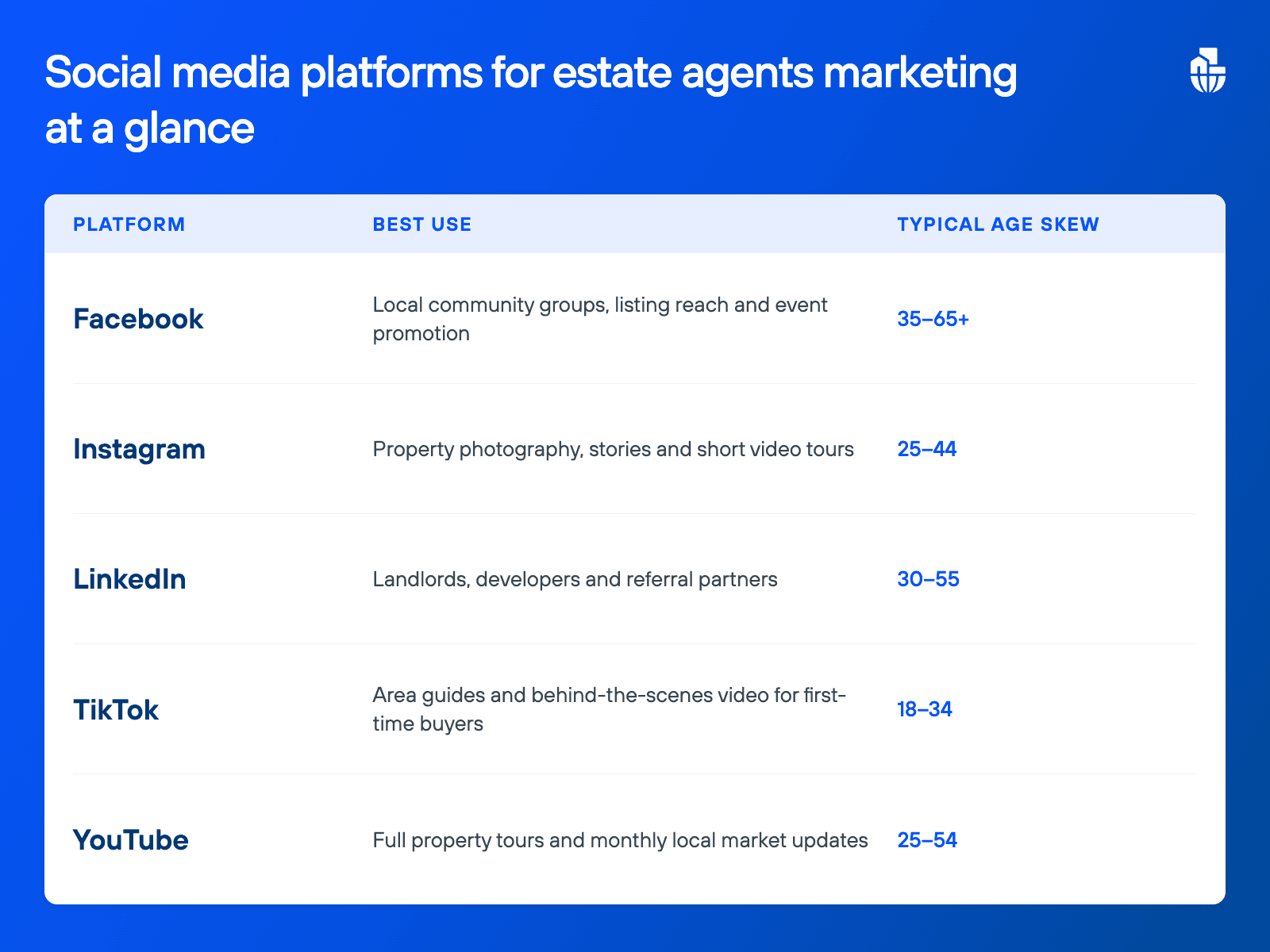
Facebook: local awareness and new listings. Skews toward a broader, somewhat older audience than Instagram or TikTok, so it's still a solid home for facebook ads targeted by postcode and age, with 35+ typically performing well for homeowner and landlord audiences.
Instagram: property photography and short-form video, strongest with buyers and renters under 35.
LinkedIn: landlords, developers, lenders and other professional relationships. Target by job title and location rather than age, since it's a B2B channel first.
TikTok: most UK estate agents still under-use this one. A short "what does £X get you in [town]" walkthrough or a first-time-buyer myth-busting series reaches a genuinely local, largely under-35 audience that other channels struggle to reach. Keep it unpolished and native to the platform; anything that sounds like an advert gets skipped in seconds.
YouTube: the natural home for longer content, full area guides, "what it's like to live in [town]" walkthroughs, and video versions of your market updates. It also compounds over time in a way a TikTok clip or a Facebook post doesn't.
Social media platforms: quick reference
Facebook: local awareness and new listings. Skews toward a broader, somewhat older audience than Instagram or TikTok, so it's still a solid home for facebook ads targeted by postcode and age, with 35+ typically performing well for homeowner and landlord audiences.
Instagram: property photography and short-form video, strongest with buyers and renters under 35.
LinkedIn: landlords, developers, lenders and other professional relationships. Target by job title and location rather than age, since it's a B2B channel first.
TikTok: most UK estate agents still under-use this one. A short "what does £X get you in [town]" walkthrough or a first-time-buyer myth-busting series reaches a genuinely local, largely under-35 audience that other channels struggle to reach. Keep it unpolished and native to the platform; anything that sounds like an advert gets skipped in seconds.
YouTube: the natural home for longer content, full area guides, "what it's like to live in [town]" walkthroughs, and video versions of your market updates. It also compounds over time in a way a TikTok clip or a Facebook post doesn't.
Social media platforms: quick reference
Facebook: local awareness and new listings. Skews toward a broader, somewhat older audience than Instagram or TikTok, so it's still a solid home for facebook ads targeted by postcode and age, with 35+ typically performing well for homeowner and landlord audiences.
Instagram: property photography and short-form video, strongest with buyers and renters under 35.
LinkedIn: landlords, developers, lenders and other professional relationships. Target by job title and location rather than age, since it's a B2B channel first.
TikTok: most UK estate agents still under-use this one. A short "what does £X get you in [town]" walkthrough or a first-time-buyer myth-busting series reaches a genuinely local, largely under-35 audience that other channels struggle to reach. Keep it unpolished and native to the platform; anything that sounds like an advert gets skipped in seconds.
YouTube: the natural home for longer content, full area guides, "what it's like to live in [town]" walkthroughs, and video versions of your market updates. It also compounds over time in a way a TikTok clip or a Facebook post doesn't.
Facebook ads in particular reward tight geographic targeting. A boosted post aimed at everyone in a 30-mile radius performs far worse than the same budget aimed precisely at the postcodes you actually cover.
6. Nurture leads properly with email marketing and a clear CRM segmentation
Most valuation enquiries and landlord introductions don't convert on the first contact. A CRM is what stops those early enquiries from disappearing, and email marketing is how you stay useful to them while they decide when to move.
Why it matters: lead generation only pays off if you can actually generate qualified leads and follow them through to an instruction, rather than losing them to a competitor who simply followed up sooner. A personalised, CRM-driven nurture sequence, rather than a single "thanks for your enquiry" email, is what does that reliably.
Resource investment: Medium, mostly in setup; light to maintain once running.
A simple lead-nurture flow
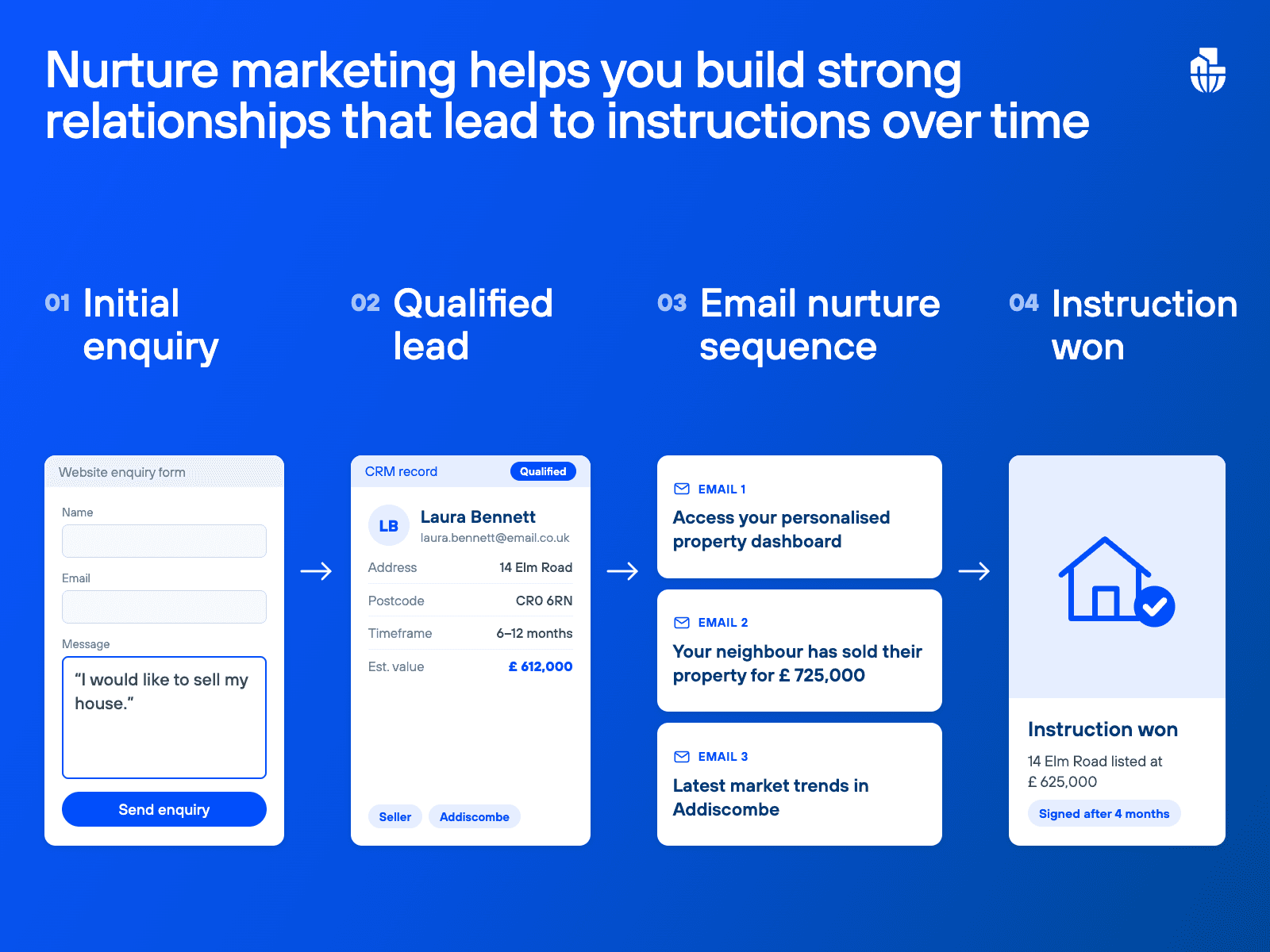
An enquiry lands in your CRM and is tagged by type (seller, landlord, buyer, or tenant).
An automated email sequence starts, spaced over several weeks, each one adding value rather than just asking for a call.
Engagement (opens, clicks, replies) upgrades the contact to a qualified lead.
A team member follows up personally once genuine interest is shown, not before.
Email campaigns work best when they're segmented. A landlord doesn't want the same content as a first-time buyer, and sending them identical newsletters is one of the fastest ways to see unsubscribe rates climb.
Facebook ads in particular reward tight geographic targeting. A boosted post aimed at everyone in a 30-mile radius performs far worse than the same budget aimed precisely at the postcodes you actually cover.
6. Nurture leads properly with email marketing and a clear CRM segmentation
Most valuation enquiries and landlord introductions don't convert on the first contact. A CRM is what stops those early enquiries from disappearing, and email marketing is how you stay useful to them while they decide when to move.
Why it matters: lead generation only pays off if you can actually generate qualified leads and follow them through to an instruction, rather than losing them to a competitor who simply followed up sooner. A personalised, CRM-driven nurture sequence, rather than a single "thanks for your enquiry" email, is what does that reliably.
Resource investment: Medium, mostly in setup; light to maintain once running.
A simple lead-nurture flow
An enquiry lands in your CRM and is tagged by type (seller, landlord, buyer, or tenant).
An automated email sequence starts, spaced over several weeks, each one adding value rather than just asking for a call.
Engagement (opens, clicks, replies) upgrades the contact to a qualified lead.
A team member follows up personally once genuine interest is shown, not before.
Email campaigns work best when they're segmented. A landlord doesn't want the same content as a first-time buyer, and sending them identical newsletters is one of the fastest ways to see unsubscribe rates climb.
Facebook ads in particular reward tight geographic targeting. A boosted post aimed at everyone in a 30-mile radius performs far worse than the same budget aimed precisely at the postcodes you actually cover.
6. Nurture leads properly with email marketing and a clear CRM segmentation
Most valuation enquiries and landlord introductions don't convert on the first contact. A CRM is what stops those early enquiries from disappearing, and email marketing is how you stay useful to them while they decide when to move.
Why it matters: lead generation only pays off if you can actually generate qualified leads and follow them through to an instruction, rather than losing them to a competitor who simply followed up sooner. A personalised, CRM-driven nurture sequence, rather than a single "thanks for your enquiry" email, is what does that reliably.
Resource investment: Medium, mostly in setup; light to maintain once running.
A simple lead-nurture flow
An enquiry lands in your CRM and is tagged by type (seller, landlord, buyer, or tenant).
An automated email sequence starts, spaced over several weeks, each one adding value rather than just asking for a call.
Engagement (opens, clicks, replies) upgrades the contact to a qualified lead.
A team member follows up personally once genuine interest is shown, not before.
Email campaigns work best when they're segmented. A landlord doesn't want the same content as a first-time buyer, and sending them identical newsletters is one of the fastest ways to see unsubscribe rates climb.
Bonus: want to take your email marketing campaigns and outreach one step further?
A well-tagged CRM gets you a long way, but the agencies furthest ahead are starting to use property data to build hyper-personalised nurture sequences.
PriceHubble's own solution for this is Seed, Signal, Sell: it lets you enrich your database with live data and helps you identify which of your contacts are showing intent signals (sales intent, purchase intent, etc.), while giving them access to a personalised property app that provides live insights into their property and the local market. In parallel, it gives all the context to your team for them to plan their marketing campaigns, and/or reach out with full context and a genuine reason to call.
It is a step beyond what most agencies need on day one, but it's where email marketing and personalised campaigns are heading next. Read more on how this works for estate agents.
Bonus: want to take your email marketing campaigns and outreach one step further?
A well-tagged CRM gets you a long way, but the agencies furthest ahead are starting to use property data to build hyper-personalised nurture sequences.
PriceHubble's own solution for this is Seed, Signal, Sell: it lets you enrich your database with live data and helps you identify which of your contacts are showing intent signals (sales intent, purchase intent, etc.), while giving them access to a personalised property app that provides live insights into their property and the local market. In parallel, it gives all the context to your team for them to plan their marketing campaigns, and/or reach out with full context and a genuine reason to call.
It is a step beyond what most agencies need on day one, but it's where email marketing and personalised campaigns are heading next. Read more on how this works for estate agents.
Bonus: want to take your email marketing campaigns and outreach one step further?
A well-tagged CRM gets you a long way, but the agencies furthest ahead are starting to use property data to build hyper-personalised nurture sequences.
PriceHubble's own solution for this is Seed, Signal, Sell: it lets you enrich your database with live data and helps you identify which of your contacts are showing intent signals (sales intent, purchase intent, etc.), while giving them access to a personalised property app that provides live insights into their property and the local market. In parallel, it gives all the context to your team for them to plan their marketing campaigns, and/or reach out with full context and a genuine reason to call.
It is a step beyond what most agencies need on day one, but it's where email marketing and personalised campaigns are heading next. Read more on how this works for estate agents.
7. Google Ads, Facebook Ads, PPC and retargeting to generate leads on your terms
Paid search and social advertising let you generate leads in the exact postcodes you want, on your own schedule, rather than waiting for organic visibility to build. PPC and Google Ads work well for high-intent searches ("valuation in [town]"), while retargeting brings back visitors who looked at your site but didn't enquire.
Why it matters: organic SEO and content take months to build momentum. Paid channels fill that gap immediately and let you test messaging quickly, which matters if you're launching in a new area or competing against agencies with a longer track record locally.
Resource investment: High, since this is ongoing spend rather than a one-off setup cost.
Choosing how to run paid ads
In-house: cheapest per hour, but requires someone with genuine PPC and analytics skills to avoid wasted spend.
A specialist digital marketing services agency: faster to get right, at a higher monthly cost.
A data-led approach: using your own hyper-local data (see strategy 3) to write ad copy and landing pages that are more specific, and typically cheaper to convert, than generic competitor ads.
Retargeting deserves particular attention. Most people who visit an estate agency website don't enquire on their first visit, so a modest retargeting budget aimed at recent visitors usually delivers a lower cost per qualified lead than cold prospecting ever does.
8. Get visible in AI search
Buyers and sellers are starting to ask LLMs like ChatGPT, Google's AI Overviews, Claude and similar tools questions like "who's a good estate agent in [town]" directly, and getting a synthesised answer rather than a list of links. Generative engine optimisation, or GEO, is how we call it. Getting cited in those answers is quickly becoming as important as classic search engine optimisation.
Why it matters: AI search tools favour content that answers a question clearly in the first few sentences, uses real numbers rather than vague claims, and is structured with clean headings. Agencies that have already built out strategies 1 to 4 properly are most of the way there already; this is largely about structure, not starting from scratch.
Resource investment: Low to medium, since it reuses content you've likely already built.
AI tools tend to trust pages that are already well-established in classic google search, so this strategy works best as a layer on top of strong SEO, not as a replacement for it.
7. Google Ads, Facebook Ads, PPC and retargeting to generate leads on your terms
Paid search and social advertising let you generate leads in the exact postcodes you want, on your own schedule, rather than waiting for organic visibility to build. PPC and Google Ads work well for high-intent searches ("valuation in [town]"), while retargeting brings back visitors who looked at your site but didn't enquire.
Why it matters: organic SEO and content take months to build momentum. Paid channels fill that gap immediately and let you test messaging quickly, which matters if you're launching in a new area or competing against agencies with a longer track record locally.
Resource investment: High, since this is ongoing spend rather than a one-off setup cost.
Choosing how to run paid ads
In-house: cheapest per hour, but requires someone with genuine PPC and analytics skills to avoid wasted spend.
A specialist digital marketing services agency: faster to get right, at a higher monthly cost.
A data-led approach: using your own hyper-local data (see strategy 3) to write ad copy and landing pages that are more specific, and typically cheaper to convert, than generic competitor ads.
Retargeting deserves particular attention. Most people who visit an estate agency website don't enquire on their first visit, so a modest retargeting budget aimed at recent visitors usually delivers a lower cost per qualified lead than cold prospecting ever does.
8. Get visible in AI search
Buyers and sellers are starting to ask LLMs like ChatGPT, Google's AI Overviews, Claude and similar tools questions like "who's a good estate agent in [town]" directly, and getting a synthesised answer rather than a list of links. Generative engine optimisation, or GEO, is how we call it. Getting cited in those answers is quickly becoming as important as classic search engine optimisation.
Why it matters: AI search tools favour content that answers a question clearly in the first few sentences, uses real numbers rather than vague claims, and is structured with clean headings. Agencies that have already built out strategies 1 to 4 properly are most of the way there already; this is largely about structure, not starting from scratch.
Resource investment: Low to medium, since it reuses content you've likely already built.
AI tools tend to trust pages that are already well-established in classic google search, so this strategy works best as a layer on top of strong SEO, not as a replacement for it.
7. Google Ads, Facebook Ads, PPC and retargeting to generate leads on your terms
Paid search and social advertising let you generate leads in the exact postcodes you want, on your own schedule, rather than waiting for organic visibility to build. PPC and Google Ads work well for high-intent searches ("valuation in [town]"), while retargeting brings back visitors who looked at your site but didn't enquire.
Why it matters: organic SEO and content take months to build momentum. Paid channels fill that gap immediately and let you test messaging quickly, which matters if you're launching in a new area or competing against agencies with a longer track record locally.
Resource investment: High, since this is ongoing spend rather than a one-off setup cost.
Choosing how to run paid ads
In-house: cheapest per hour, but requires someone with genuine PPC and analytics skills to avoid wasted spend.
A specialist digital marketing services agency: faster to get right, at a higher monthly cost.
A data-led approach: using your own hyper-local data (see strategy 3) to write ad copy and landing pages that are more specific, and typically cheaper to convert, than generic competitor ads.
Retargeting deserves particular attention. Most people who visit an estate agency website don't enquire on their first visit, so a modest retargeting budget aimed at recent visitors usually delivers a lower cost per qualified lead than cold prospecting ever does.
8. Get visible in AI search
Buyers and sellers are starting to ask LLMs like ChatGPT, Google's AI Overviews, Claude and similar tools questions like "who's a good estate agent in [town]" directly, and getting a synthesised answer rather than a list of links. Generative engine optimisation, or GEO, is how we call it. Getting cited in those answers is quickly becoming as important as classic search engine optimisation.
Why it matters: AI search tools favour content that answers a question clearly in the first few sentences, uses real numbers rather than vague claims, and is structured with clean headings. Agencies that have already built out strategies 1 to 4 properly are most of the way there already; this is largely about structure, not starting from scratch.
Resource investment: Low to medium, since it reuses content you've likely already built.
AI tools tend to trust pages that are already well-established in classic google search, so this strategy works best as a layer on top of strong SEO, not as a replacement for it.
Is your content AI-search ready?
Does each page answer its main question in the first 40 to 60 words, in plain language?
Do you use real, sourced numbers rather than adjectives like "fast" or "competitive"?
Is your content structured with clear, descriptive headings and clear sections?
Do you have a genuine FAQ section using the exact questions clients actually ask?
Is the page updated at least every few months?
AI tools also tend to trust pages that are already well established in classic search, so this strategy works best as a layer on top of strong SEO, not a replacement for it.
Is your content AI-search ready?
Does each page answer its main question in the first 40 to 60 words, in plain language?
Do you use real, sourced numbers rather than adjectives like "fast" or "competitive"?
Is your content structured with clear, descriptive headings and clear sections?
Do you have a genuine FAQ section using the exact questions clients actually ask?
Is the page updated at least every few months?
AI tools also tend to trust pages that are already well established in classic search, so this strategy works best as a layer on top of strong SEO, not a replacement for it.
Is your content AI-search ready?
Does each page answer its main question in the first 40 to 60 words, in plain language?
Do you use real, sourced numbers rather than adjectives like "fast" or "competitive"?
Is your content structured with clear, descriptive headings and clear sections?
Do you have a genuine FAQ section using the exact questions clients actually ask?
Is the page updated at least every few months?
AI tools also tend to trust pages that are already well established in classic search, so this strategy works best as a layer on top of strong SEO, not a replacement for it.
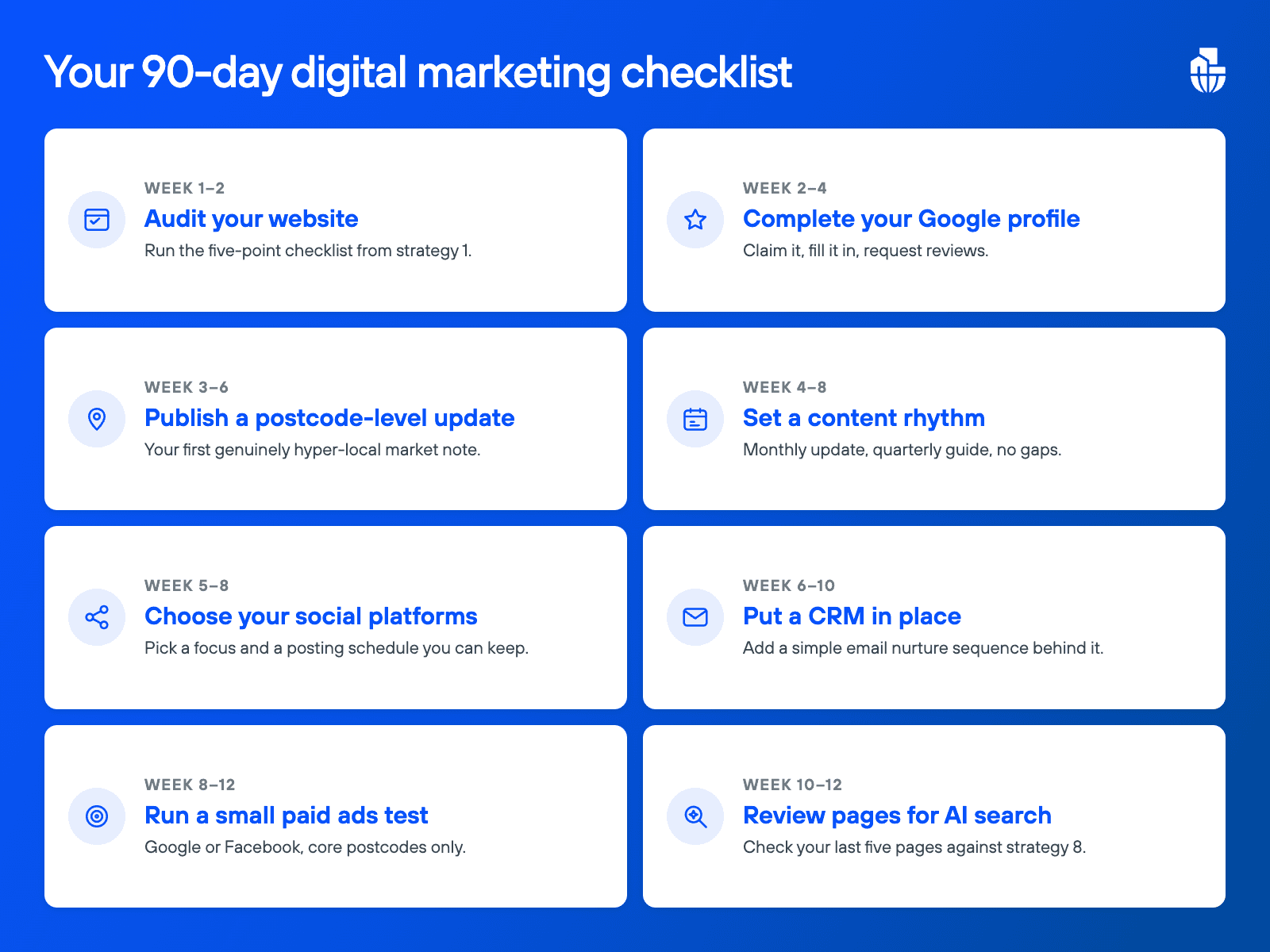
Your 90-day digital marketing checklist
Week 1–2: Audit your estate agency website against the five-point checklist in strategy 1.
Week 2–4: Claim and complete your Google Business profile, and start actively requesting reviews.
Week 3–6: Pull your first genuinely hyper-local, postcode-level market update and publish it.
Week 4–8: Set a content rhythm (monthly update, quarterly guide) and stick to it.
Week 5–8: Confirm which social media platforms you'll focus on, and set a realistic posting schedule.
Week 6–10: Get a CRM in place, or review your existing one, and build a simple email nurture sequence.
Week 8–12: Launch a small, well-targeted Google ads or Facebook ads test in your core postcodes.
Week 10–12: Review your last five published pages against the AI-search checklist in strategy 8, and fix any gaps.
Your 90-day digital marketing checklist
Week 1–2: Audit your estate agency website against the five-point checklist in strategy 1.
Week 2–4: Claim and complete your Google Business profile, and start actively requesting reviews.
Week 3–6: Pull your first genuinely hyper-local, postcode-level market update and publish it.
Week 4–8: Set a content rhythm (monthly update, quarterly guide) and stick to it.
Week 5–8: Confirm which social media platforms you'll focus on, and set a realistic posting schedule.
Week 6–10: Get a CRM in place, or review your existing one, and build a simple email nurture sequence.
Week 8–12: Launch a small, well-targeted Google ads or Facebook ads test in your core postcodes.
Week 10–12: Review your last five published pages against the AI-search checklist in strategy 8, and fix any gaps.
Your 90-day digital marketing checklist
Week 1–2: Audit your estate agency website against the five-point checklist in strategy 1.
Week 2–4: Claim and complete your Google Business profile, and start actively requesting reviews.
Week 3–6: Pull your first genuinely hyper-local, postcode-level market update and publish it.
Week 4–8: Set a content rhythm (monthly update, quarterly guide) and stick to it.
Week 5–8: Confirm which social media platforms you'll focus on, and set a realistic posting schedule.
Week 6–10: Get a CRM in place, or review your existing one, and build a simple email nurture sequence.
Week 8–12: Launch a small, well-targeted Google ads or Facebook ads test in your core postcodes.
Week 10–12: Review your last five published pages against the AI-search checklist in strategy 8, and fix any gaps.
The bottom line: consistency wins in estate agent marketing
So, where does that leave you? Digital marketing for estate agents was never really about picking one channel and hoping it delivers. It's a solid estate agency website, genuine local search visibility, content built on real hyper-local data, an active social media presence pitched at the right platforms and the right ages, a CRM that actually nurtures leads instead of losing them, targeted paid advertising, and, increasingly, a structure that AI search tools can read and trust. None of it works in isolation, and none of it needs to be perfect on day one.
Start with whichever estate agent marketing strategy above feels furthest behind for you, work through the 90-day checklist, and revisit it every quarter as your local market moves. The agencies picking up the most instructions in 2026 aren't necessarily the biggest names on the high street. They're the ones showing up, consistently, wherever their next seller or landlord happens to be looking: on Google, on social media, and now increasingly in the answer an AI tool gives when somebody simply asks who to call.
The bottom line: consistency wins in estate agent marketing
So, where does that leave you? Digital marketing for estate agents was never really about picking one channel and hoping it delivers. It's a solid estate agency website, genuine local search visibility, content built on real hyper-local data, an active social media presence pitched at the right platforms and the right ages, a CRM that actually nurtures leads instead of losing them, targeted paid advertising, and, increasingly, a structure that AI search tools can read and trust. None of it works in isolation, and none of it needs to be perfect on day one.
Start with whichever estate agent marketing strategy above feels furthest behind for you, work through the 90-day checklist, and revisit it every quarter as your local market moves. The agencies picking up the most instructions in 2026 aren't necessarily the biggest names on the high street. They're the ones showing up, consistently, wherever their next seller or landlord happens to be looking: on Google, on social media, and now increasingly in the answer an AI tool gives when somebody simply asks who to call.
The bottom line: consistency wins in estate agent marketing
So, where does that leave you? Digital marketing for estate agents was never really about picking one channel and hoping it delivers. It's a solid estate agency website, genuine local search visibility, content built on real hyper-local data, an active social media presence pitched at the right platforms and the right ages, a CRM that actually nurtures leads instead of losing them, targeted paid advertising, and, increasingly, a structure that AI search tools can read and trust. None of it works in isolation, and none of it needs to be perfect on day one.
Start with whichever estate agent marketing strategy above feels furthest behind for you, work through the 90-day checklist, and revisit it every quarter as your local market moves. The agencies picking up the most instructions in 2026 aren't necessarily the biggest names on the high street. They're the ones showing up, consistently, wherever their next seller or landlord happens to be looking: on Google, on social media, and now increasingly in the answer an AI tool gives when somebody simply asks who to call.
Estate agency marketing: Frequently asked questions
What is the best online marketing for estate agents? There's no single best channel. The agencies that perform most consistently combine a strong estate agent website, active local SEO through a well-maintained Google Business profile, genuine hyper-local content, and a CRM that actually nurtures enquiries rather than letting them go cold.
How important are digital marketing skills for an estate agent? Very important. Agents who understand the basics of local SEO, content marketing and email marketing tend to generate more qualified leads at a lower cost than those relying purely on paid advertising or word of mouth, because organic channels keep working between campaigns.
How can a smaller estate agency compete on digital marketing against larger competitors? Usually through specificity rather than budget. A smaller agency with genuinely hyper-local data and a consistent content marketing habit often outperforms a larger competitor's generic national campaigns in its own patch, at a fraction of the cost.
What digital marketing services does an estate agency actually need? At minimum: a fast, well-structured website, an active Google Business profile, a basic CRM with email nurture sequences, and a content plan built around local data. PPC, social media marketing and retargeting are worth adding once those fundamentals are solid.
Do letting agents need a different digital marketing approach to estate agents? The channels are largely the same, but the content differs. Letting agents benefit particularly from landlord-focused content (yield data, rental market trends, compliance updates) and a LinkedIn presence aimed at landlords and developers, alongside the tenant-facing side of the business.
How does AI search change digital marketing for estate agents? AI search raises the bar on clarity and evidence compared to regular Google searches. Content that answers a question directly, in plain language, backed by real numbers, is what AI tools like ChatGPT and Google's AI Overviews tend to surface. Vague, adjective-heavy marketing copy is the first thing they skip over.
Estate agency marketing: Frequently asked questions
What is the best online marketing for estate agents? There's no single best channel. The agencies that perform most consistently combine a strong estate agent website, active local SEO through a well-maintained Google Business profile, genuine hyper-local content, and a CRM that actually nurtures enquiries rather than letting them go cold.
How important are digital marketing skills for an estate agent? Very important. Agents who understand the basics of local SEO, content marketing and email marketing tend to generate more qualified leads at a lower cost than those relying purely on paid advertising or word of mouth, because organic channels keep working between campaigns.
How can a smaller estate agency compete on digital marketing against larger competitors? Usually through specificity rather than budget. A smaller agency with genuinely hyper-local data and a consistent content marketing habit often outperforms a larger competitor's generic national campaigns in its own patch, at a fraction of the cost.
What digital marketing services does an estate agency actually need? At minimum: a fast, well-structured website, an active Google Business profile, a basic CRM with email nurture sequences, and a content plan built around local data. PPC, social media marketing and retargeting are worth adding once those fundamentals are solid.
Do letting agents need a different digital marketing approach to estate agents? The channels are largely the same, but the content differs. Letting agents benefit particularly from landlord-focused content (yield data, rental market trends, compliance updates) and a LinkedIn presence aimed at landlords and developers, alongside the tenant-facing side of the business.
How does AI search change digital marketing for estate agents? AI search raises the bar on clarity and evidence compared to regular Google searches. Content that answers a question directly, in plain language, backed by real numbers, is what AI tools like ChatGPT and Google's AI Overviews tend to surface. Vague, adjective-heavy marketing copy is the first thing they skip over.
Estate agency marketing: Frequently asked questions
What is the best online marketing for estate agents? There's no single best channel. The agencies that perform most consistently combine a strong estate agent website, active local SEO through a well-maintained Google Business profile, genuine hyper-local content, and a CRM that actually nurtures enquiries rather than letting them go cold.
How important are digital marketing skills for an estate agent? Very important. Agents who understand the basics of local SEO, content marketing and email marketing tend to generate more qualified leads at a lower cost than those relying purely on paid advertising or word of mouth, because organic channels keep working between campaigns.
How can a smaller estate agency compete on digital marketing against larger competitors? Usually through specificity rather than budget. A smaller agency with genuinely hyper-local data and a consistent content marketing habit often outperforms a larger competitor's generic national campaigns in its own patch, at a fraction of the cost.
What digital marketing services does an estate agency actually need? At minimum: a fast, well-structured website, an active Google Business profile, a basic CRM with email nurture sequences, and a content plan built around local data. PPC, social media marketing and retargeting are worth adding once those fundamentals are solid.
Do letting agents need a different digital marketing approach to estate agents? The channels are largely the same, but the content differs. Letting agents benefit particularly from landlord-focused content (yield data, rental market trends, compliance updates) and a LinkedIn presence aimed at landlords and developers, alongside the tenant-facing side of the business.
How does AI search change digital marketing for estate agents? AI search raises the bar on clarity and evidence compared to regular Google searches. Content that answers a question directly, in plain language, backed by real numbers, is what AI tools like ChatGPT and Google's AI Overviews tend to surface. Vague, adjective-heavy marketing copy is the first thing they skip over.
See also
News
Read more →

News
Read more →

News
Read more →
Request a demo
We will get back to you quickly.
We look forward to speaking with you.
Thank you!
We will get back to you within 24 business hours.

Thank you!
We will get back to you within 24 business hours.