Sustainability in real estate: A market outlook on Europe’s landscape
Best Practices & Trends
Published by
PriceHubble
-

Sustainability in real estate: A market outlook on Europe’s landscape
Best Practices & Trends
Published by
PriceHubble
-
Sustainability in real estate: A market outlook on Europe’s landscape
Best Practices & Trends
Published by
PriceHubble
-
With the real estate industry accounting for approximately 40% of Europe’s energy consumption and 36% of Europe’s greenhouse gas emissions (source: European Commission), sustainability in real estate has gained significant relevance in recent years.
In this context, Environmental, Social, and Governance (ESG) topics have become increasingly prominent as a crucial initiative to address climate change and foster a more sustainable future. Therefore, the European Union and its member states have implemented new ESG-related guidelines and directives within the real estate sector. At a country level, rating schemes like the DPE (diagnostic de performance énergétique) in France, Germany’s Effizienzhaus-55 standard, or the Minimum Energy Efficiency Standards (MEES) in the UK have emerged.
This shift toward sustainability represents a responsible decision for the planet’s well-being and a logical choice for forward-thinking investors, developers, financial stakeholders, and real estate agents. This article delves into what sustainability means for the real estate sector, focusing specifically on its increasing significance in Europe. It highlights the advantages and obstacles associated with implementing future-proof sustainable initiatives in real estate. It also emphasises the importance of solutions that provide reliable and crucial energy-related data and metrics.
With the real estate industry accounting for approximately 40% of Europe’s energy consumption and 36% of Europe’s greenhouse gas emissions (source: European Commission), sustainability in real estate has gained significant relevance in recent years.
In this context, Environmental, Social, and Governance (ESG) topics have become increasingly prominent as a crucial initiative to address climate change and foster a more sustainable future. Therefore, the European Union and its member states have implemented new ESG-related guidelines and directives within the real estate sector. At a country level, rating schemes like the DPE (diagnostic de performance énergétique) in France, Germany’s Effizienzhaus-55 standard, or the Minimum Energy Efficiency Standards (MEES) in the UK have emerged.
This shift toward sustainability represents a responsible decision for the planet’s well-being and a logical choice for forward-thinking investors, developers, financial stakeholders, and real estate agents. This article delves into what sustainability means for the real estate sector, focusing specifically on its increasing significance in Europe. It highlights the advantages and obstacles associated with implementing future-proof sustainable initiatives in real estate. It also emphasises the importance of solutions that provide reliable and crucial energy-related data and metrics.
With the real estate industry accounting for approximately 40% of Europe’s energy consumption and 36% of Europe’s greenhouse gas emissions (source: European Commission), sustainability in real estate has gained significant relevance in recent years.
In this context, Environmental, Social, and Governance (ESG) topics have become increasingly prominent as a crucial initiative to address climate change and foster a more sustainable future. Therefore, the European Union and its member states have implemented new ESG-related guidelines and directives within the real estate sector. At a country level, rating schemes like the DPE (diagnostic de performance énergétique) in France, Germany’s Effizienzhaus-55 standard, or the Minimum Energy Efficiency Standards (MEES) in the UK have emerged.
This shift toward sustainability represents a responsible decision for the planet’s well-being and a logical choice for forward-thinking investors, developers, financial stakeholders, and real estate agents. This article delves into what sustainability means for the real estate sector, focusing specifically on its increasing significance in Europe. It highlights the advantages and obstacles associated with implementing future-proof sustainable initiatives in real estate. It also emphasises the importance of solutions that provide reliable and crucial energy-related data and metrics.
What is sustainability in real estate?
Sustainability in real estate includes designing, constructing, renovating, and managing residential and commercial properties to minimise the sector's environmental impact. The focus on sustainability in the real estate sector is driven by various factors, including global awareness of environmental preservation, increasingly stringent regulations, and the need to save operational costs.
Implementing sustainable practices involves several critical steps for professionals. Prioritising environmentally friendly building materials and sustainable development practices is the first initiative that can be easily implemented, but it’s not the only one. Additionally, adhering to regular maintenance schedules ensures the longevity of structures. Using energy-efficient lighting and appliances further contributes to sustainability efforts. Last but not least, investing in on-site renewable energy systems, such as solar panels, wind turbines, micro-hydropower, and hybrid systems, is crucial for reducing the environmental impact and promoting long-term sustainability, as it can help significantly reduce CO2 emissions.
How do real estate professionals benefit from integrating sustainability into their strategies?
In the current landscape, there is an urgent need for professionals to include sustainable strategies in their daily activities. Adopting a sustainable strategy not only allows them to meet regulatory requirements but also enables them to enhance their impact and success significantly.
For businesses committed to having a more positive impact, focusing on sustainable real estate offers several advantages:
Cost savings: Sustainable buildings and renovations are designed to use resources efficiently, reducing costs associated with heating, cooling, and overall building operations.
Increased value: Green buildings and real estate units meeting current sustainability standards with updated infrastructure tend to have a higher value. but According to our automated valuation model, properties in Germany with low energy efficiency (label H) are worth between 14% and 19% less on average than those with high energy efficiency (label A). For properties in France, our model shows that energy-inefficient homes (label G) are up to 7.2% less valuable than those with high energy efficiency (label B).
Reduced carbon footprint and environmental impact: Building, renovating or investing in sustainable buildings ensures minimal carbon emissions throughout the project lifecycle. This approach mitigates negative impacts on the environment, biodiversity, and communities from design and construction to operation.
What is sustainability in real estate?
Sustainability in real estate includes designing, constructing, renovating, and managing residential and commercial properties to minimise the sector's environmental impact. The focus on sustainability in the real estate sector is driven by various factors, including global awareness of environmental preservation, increasingly stringent regulations, and the need to save operational costs.
Implementing sustainable practices involves several critical steps for professionals. Prioritising environmentally friendly building materials and sustainable development practices is the first initiative that can be easily implemented, but it’s not the only one. Additionally, adhering to regular maintenance schedules ensures the longevity of structures. Using energy-efficient lighting and appliances further contributes to sustainability efforts. Last but not least, investing in on-site renewable energy systems, such as solar panels, wind turbines, micro-hydropower, and hybrid systems, is crucial for reducing the environmental impact and promoting long-term sustainability, as it can help significantly reduce CO2 emissions.
How do real estate professionals benefit from integrating sustainability into their strategies?
In the current landscape, there is an urgent need for professionals to include sustainable strategies in their daily activities. Adopting a sustainable strategy not only allows them to meet regulatory requirements but also enables them to enhance their impact and success significantly.
For businesses committed to having a more positive impact, focusing on sustainable real estate offers several advantages:
Cost savings: Sustainable buildings and renovations are designed to use resources efficiently, reducing costs associated with heating, cooling, and overall building operations.
Increased value: Green buildings and real estate units meeting current sustainability standards with updated infrastructure tend to have a higher value. but According to our automated valuation model, properties in Germany with low energy efficiency (label H) are worth between 14% and 19% less on average than those with high energy efficiency (label A). For properties in France, our model shows that energy-inefficient homes (label G) are up to 7.2% less valuable than those with high energy efficiency (label B).
Reduced carbon footprint and environmental impact: Building, renovating or investing in sustainable buildings ensures minimal carbon emissions throughout the project lifecycle. This approach mitigates negative impacts on the environment, biodiversity, and communities from design and construction to operation.
What is sustainability in real estate?
Sustainability in real estate includes designing, constructing, renovating, and managing residential and commercial properties to minimise the sector's environmental impact. The focus on sustainability in the real estate sector is driven by various factors, including global awareness of environmental preservation, increasingly stringent regulations, and the need to save operational costs.
Implementing sustainable practices involves several critical steps for professionals. Prioritising environmentally friendly building materials and sustainable development practices is the first initiative that can be easily implemented, but it’s not the only one. Additionally, adhering to regular maintenance schedules ensures the longevity of structures. Using energy-efficient lighting and appliances further contributes to sustainability efforts. Last but not least, investing in on-site renewable energy systems, such as solar panels, wind turbines, micro-hydropower, and hybrid systems, is crucial for reducing the environmental impact and promoting long-term sustainability, as it can help significantly reduce CO2 emissions.
How do real estate professionals benefit from integrating sustainability into their strategies?
In the current landscape, there is an urgent need for professionals to include sustainable strategies in their daily activities. Adopting a sustainable strategy not only allows them to meet regulatory requirements but also enables them to enhance their impact and success significantly.
For businesses committed to having a more positive impact, focusing on sustainable real estate offers several advantages:
Cost savings: Sustainable buildings and renovations are designed to use resources efficiently, reducing costs associated with heating, cooling, and overall building operations.
Increased value: Green buildings and real estate units meeting current sustainability standards with updated infrastructure tend to have a higher value. but According to our automated valuation model, properties in Germany with low energy efficiency (label H) are worth between 14% and 19% less on average than those with high energy efficiency (label A). For properties in France, our model shows that energy-inefficient homes (label G) are up to 7.2% less valuable than those with high energy efficiency (label B).
Reduced carbon footprint and environmental impact: Building, renovating or investing in sustainable buildings ensures minimal carbon emissions throughout the project lifecycle. This approach mitigates negative impacts on the environment, biodiversity, and communities from design and construction to operation.
Did you know PriceHubble provides crucial property insights, including energy performance data? Using our residential property valuation solutions, you can seamlessly integrate ESG into your strategic approach. Book a free demo now to learn more:
Did you know PriceHubble provides crucial property insights, including energy performance data? Using our residential property valuation solutions, you can seamlessly integrate ESG into your strategic approach. Book a free demo now to learn more:
Did you know PriceHubble provides crucial property insights, including energy performance data? Using our residential property valuation solutions, you can seamlessly integrate ESG into your strategic approach. Book a free demo now to learn more:
What are the challenges when taking steps towards real estate sustainability?
Sustainable real estate aims to meet current needs while ensuring the ability of future generations to meet theirs. This means creating environmentally responsible, socially equitable, and economically prosperous buildings and communities in the built environment and real estate sector. It encompasses building, renovating and revitalising existing structures, promoting a holistic approach to sustainability in the real estate sector.
Nevertheless, integrating sustainability in the real estate sector can create various challenges. One of them is the need for uniform standards. Multiple rating systems and indicators exist for assessing sustainability (such as DPE in France, “Effizienzhaus-55” in Germany, or MEES in the UK), yet no universally recognised system exists. This lack of standardisation makes it more difficult for investors to compare properties and make well-informed real estate investment decisions.
Despite the increasing importance of sustainability in the real estate sector, accessing and leveraging EPC-related data remains a challenge. The lack of solutions offering complete transparency on such crucial insights hinders institutional investors, banks, risk departments and those responsible for real estate development in identifying potential climate risks and meeting requirements.
Foster sustainability with PriceHubble’s data-driven solutions
In today’s landscape, financial institutions and real estate investors are responsible for accessing comprehensive and precise energy performance data. By accessing these insights, they can understand the influence of energy performance on real estate value. They can analyse climate risks and ESG-related risks, advise customers on sustainability matters, and make sustainable real estate decisions.
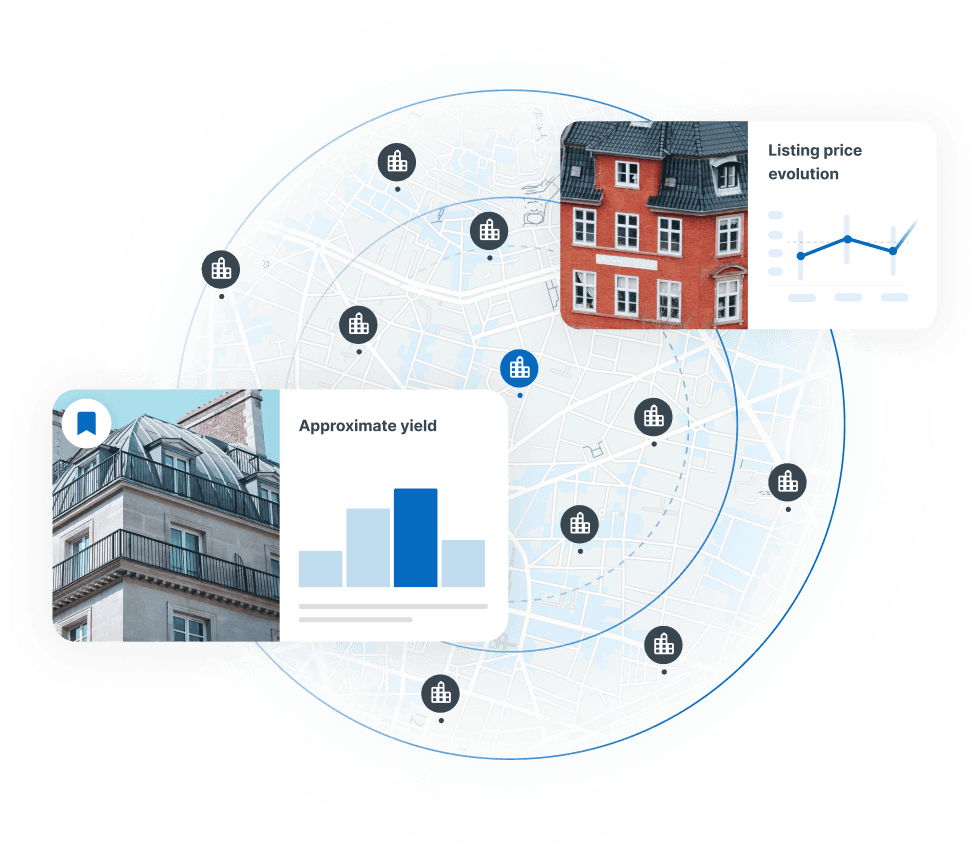
At PriceHubble, we have strategically embedded sustainability considerations into our strategy, leveraging our unique expertise in the European market. Our cutting-edge digital solutions offer unparalleled valuations, insights and analyses. If you seek to enrich your property data with energy performance insights, evaluate how it impacts your portfolio’s value or want to learn more about our solutions, feel free to reach out.
What are the challenges when taking steps towards real estate sustainability?
Sustainable real estate aims to meet current needs while ensuring the ability of future generations to meet theirs. This means creating environmentally responsible, socially equitable, and economically prosperous buildings and communities in the built environment and real estate sector. It encompasses building, renovating and revitalising existing structures, promoting a holistic approach to sustainability in the real estate sector.
Nevertheless, integrating sustainability in the real estate sector can create various challenges. One of them is the need for uniform standards. Multiple rating systems and indicators exist for assessing sustainability (such as DPE in France, “Effizienzhaus-55” in Germany, or MEES in the UK), yet no universally recognised system exists. This lack of standardisation makes it more difficult for investors to compare properties and make well-informed real estate investment decisions.
Despite the increasing importance of sustainability in the real estate sector, accessing and leveraging EPC-related data remains a challenge. The lack of solutions offering complete transparency on such crucial insights hinders institutional investors, banks, risk departments and those responsible for real estate development in identifying potential climate risks and meeting requirements.
Foster sustainability with PriceHubble’s data-driven solutions
In today’s landscape, financial institutions and real estate investors are responsible for accessing comprehensive and precise energy performance data. By accessing these insights, they can understand the influence of energy performance on real estate value. They can analyse climate risks and ESG-related risks, advise customers on sustainability matters, and make sustainable real estate decisions.
At PriceHubble, we have strategically embedded sustainability considerations into our strategy, leveraging our unique expertise in the European market. Our cutting-edge digital solutions offer unparalleled valuations, insights and analyses. If you seek to enrich your property data with energy performance insights, evaluate how it impacts your portfolio’s value or want to learn more about our solutions, feel free to reach out.
What are the challenges when taking steps towards real estate sustainability?
Sustainable real estate aims to meet current needs while ensuring the ability of future generations to meet theirs. This means creating environmentally responsible, socially equitable, and economically prosperous buildings and communities in the built environment and real estate sector. It encompasses building, renovating and revitalising existing structures, promoting a holistic approach to sustainability in the real estate sector.
Nevertheless, integrating sustainability in the real estate sector can create various challenges. One of them is the need for uniform standards. Multiple rating systems and indicators exist for assessing sustainability (such as DPE in France, “Effizienzhaus-55” in Germany, or MEES in the UK), yet no universally recognised system exists. This lack of standardisation makes it more difficult for investors to compare properties and make well-informed real estate investment decisions.
Despite the increasing importance of sustainability in the real estate sector, accessing and leveraging EPC-related data remains a challenge. The lack of solutions offering complete transparency on such crucial insights hinders institutional investors, banks, risk departments and those responsible for real estate development in identifying potential climate risks and meeting requirements.
Foster sustainability with PriceHubble’s data-driven solutions
In today’s landscape, financial institutions and real estate investors are responsible for accessing comprehensive and precise energy performance data. By accessing these insights, they can understand the influence of energy performance on real estate value. They can analyse climate risks and ESG-related risks, advise customers on sustainability matters, and make sustainable real estate decisions.
At PriceHubble, we have strategically embedded sustainability considerations into our strategy, leveraging our unique expertise in the European market. Our cutting-edge digital solutions offer unparalleled valuations, insights and analyses. If you seek to enrich your property data with energy performance insights, evaluate how it impacts your portfolio’s value or want to learn more about our solutions, feel free to reach out.
Request a demo
We will get back to you quickly.
We look forward to speaking with you.
Thank you!
We will get back to you within 24 business hours.

Thank you!
We will get back to you within 24 business hours.