The seller has already decided to move; the question is whether they call you first
Best Practices & Trends
Published by
PriceHubble
-

The seller has already decided to move; the question is whether they call you first
Best Practices & Trends
Published by
PriceHubble
-
The seller has already decided to move; the question is whether they call you first
Best Practices & Trends
Published by
PriceHubble
-
A homeowner decides to sell. They think about which agent to call. They remember the one who sent them something useful three months ago, a note about a comparable sale on their street, a market update that was actually relevant to their situation. They call that agent.
Your team never knew the seller was thinking about selling. They find out when the listing appears on a portal under a competitor's name.
This is not a prospecting failure. It is a timing failure. And it is the most common way real estate agencies lose instructions they should have won.
The problem with how most agencies find new business
Most real estate agencies run on a mix of inbound enquiries, referrals, and outbound prospecting. The inbound is unpredictable. The referrals are finite. The outbound, whether cold calling, door knocking, or generic email campaigns, is expensive, time-consuming, and increasingly ineffective.
What none of these approaches solve is the fundamental visibility problem: not knowing which property owners in your database or your market are approaching a decision, and not being present at the moment they start thinking about it.
A homeowner who has owned their property for ten years, whose local market has shifted significantly, and who has started checking their valuation repeatedly should tell you something. A contact who requested an EPC assessment on their property and recently browsed listings in a new area should tell you something different but equally useful. These signals exist. Most agencies have no way of reading them.
What Seed, Signal, Sell means for real estate agencies
PriceHubble built the Seed, Signal, Sell framework to give agencies exactly this capability: a continuous system that monitors property owners in their contact base, detects the signals that indicate intent, and creates the right reason to reach out before the competition does.
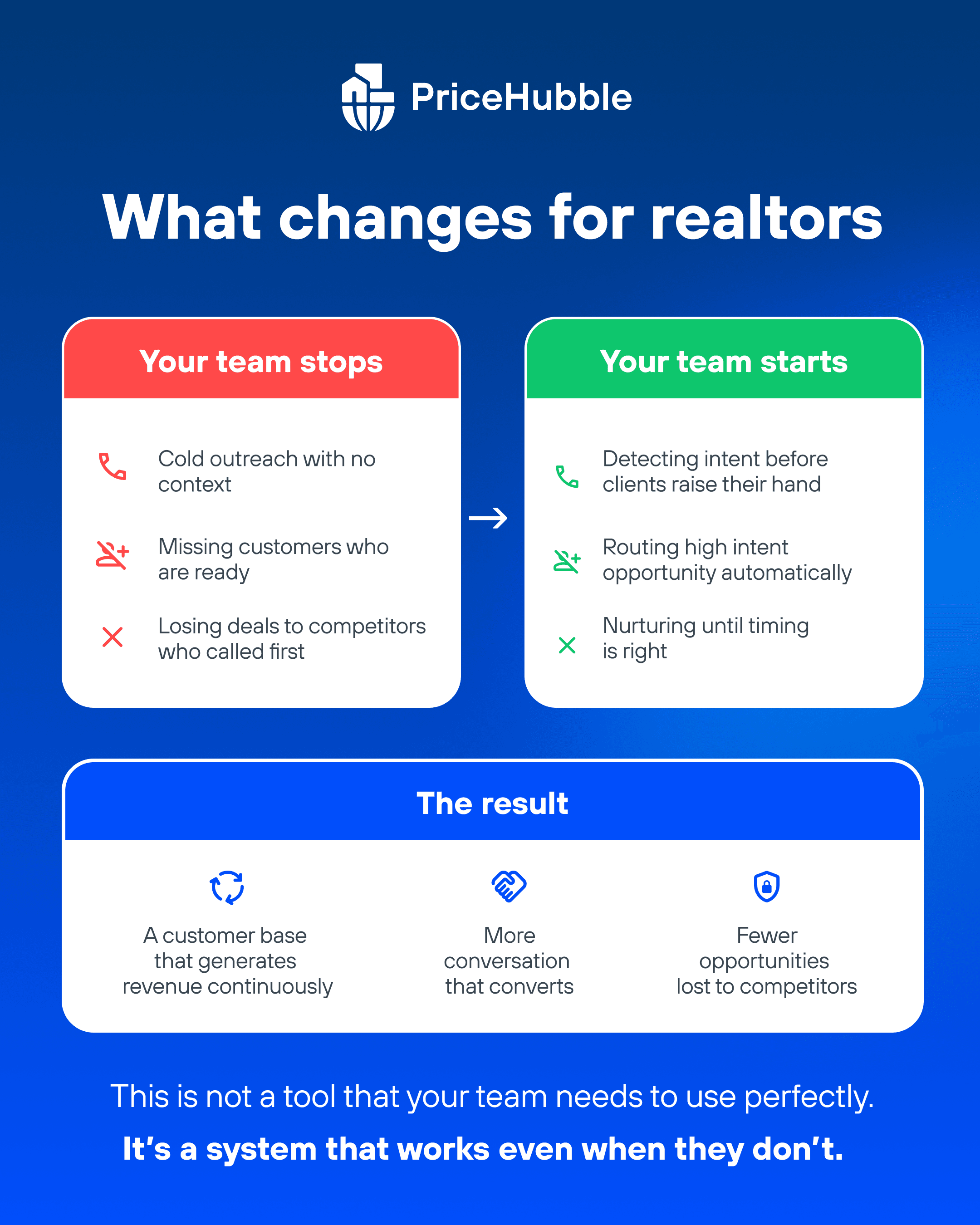
It works for existing contacts and for net new relationships, whether you are an independent agent managing a local patch or a large firm with thousands of contacts across multiple markets. It runs autonomously in the background, building intelligence on every contact. This is not a tool that requires perfect adoption. It’s a system that works even when your agents are not looking.
Here is how each stage works in practice.
Seed is about building and maintaining a presence with every property owner in your world, whether they are a past client, a contact who has never transacted with you, or a homeowner in your target area who has engaged with your brand online.
Every contact is connected to their property and given access to a branded property experience: a personalised portal where they can monitor their property value, track what comparable homes have sold for, follow local market trends, and explore what their home might be worth if they were to sell. This runs under your agency's brand and keeps you present in a property owner's life between transactions, which in real estate can be years apart.
For net new contacts, the Property App works as a lead generation tool. Homeowners who have no existing relationship with your agency can discover it, engage with their property data, and enter your pipeline already signalling intent through their behaviour.
Every interaction with the app generates data. How often are they checking their valuation? Have they started browsing listings in a different area? Have they used the renovation simulator? This behavioural layer is what makes the Signal stage possible.
And it starts earlier than the first interaction. Every contact in your portfolio is automatically matched to the property they own and enriched with live property intelligence before they ever open the app. Your client base comes alive, every name backed by real property context, ready to be monitored and acted on.
Signal is where the system earns its value, and it works in two directions.
In one direction, PriceHubble continuously monitors changes across property, contact, and behavioural data, looking for the combinations that indicate a homeowner is moving towards a decision. A contact who has owned their home for a significant period, whose property has crossed a meaningful value milestone, and who has started browsing comparable listings: that is a likely seller. A contact who has been browsing listings in a new area and opened a mortgage calculator: that is a likely buyer, and possibly a seller too. The system looks for these combinations and scores them, so your agents know which opportunities are worth acting on first.
In the other direction, the system proactively reaches property owners with personalised, relevant information about their home and their market. For example: A comparable property just sold nearby. Their home has crossed a significant value threshold. A construction project launches in their area. Their ownership anniversary is approaching. These are not generic newsletters. They are specific, timely nudges that keep your brand present and prompt homeowners to think about their next move before they have started looking for an agent.
This is how you create the moment rather than waiting for it to arrive.
Sell is where the signal becomes an instruction. When a high-priority combination fires, the system routes it to the right action: an automated personalised outreach, an AI-assisted call, or an alert to an agent with full context and a suggested approach already prepared.
The agent does not start cold. They start knowing that this particular homeowner has checked their valuation four times in the past month, that a comparable property on their street sold last week for a strong price, and that their ownership anniversary is in three weeks. That is not a cold call. That is a conversation with a reason behind it, and it lands very differently.
If the timing is not yet right, the system continues nurturing and re-engages automatically when conditions change.
What this looks like on the ground
A homeowner has been in your contact base for seven years, a past client you helped buy their current home. They have not been in touch since. Over the past few weeks, the system detects that their property has appreciated significantly, that they requested an EPC assessment recently, and that they have checked their own valuation three times after receiving a market update from your branded app.
None of your agents know this yet.
The system scores the combination as high-priority seller intent and triggers an outreach. The agent receives an alert with full context and a ready-made talking point: a comparable sale on the client's street, a strong local market, a natural moment to have a conversation about what their property is worth today. The homeowner receives a message that feels like the agent has been paying attention, because the system has been.
That conversation happens weeks before the homeowner has started thinking about which agent to call. Which means it is already won.
A reason to call that does not feel like a sales call
One of the most practical benefits of the framework is what it does to the quality of every agent interaction. When an agent reaches out because a comparable property on a homeowner's street just sold for a record price, that is not a cold call. It is useful information delivered at exactly the right moment. The homeowner receives it as service, not solicitation.
The system surfaces these talking points automatically for every contact in your base: value milestones crossed, comparable sales nearby, shifts in local demand, ownership anniversaries, market trend changes. Every agent, at every firm, has a relevant reason to reach out to every contact without having to research it manually.
For independent agents, this means never missing a seller in your patch because you were focused elsewhere. For large firms, it means consistent, insight-led prospecting across entire markets without relying on individual agents to identify opportunities on their own.
The difference between an agency that calls when it needs listings and one that calls when it has something worth saying is not talent. It is infrastructure.
PriceHubble provides property intelligence and the Seed, Signal, Sell growth engine for real estate agencies across Europe and beyond. Get in touch to see what it looks like on your contact base.
A homeowner decides to sell. They think about which agent to call. They remember the one who sent them something useful three months ago, a note about a comparable sale on their street, a market update that was actually relevant to their situation. They call that agent.
Your team never knew the seller was thinking about selling. They find out when the listing appears on a portal under a competitor's name.
This is not a prospecting failure. It is a timing failure. And it is the most common way real estate agencies lose instructions they should have won.
The problem with how most agencies find new business
Most real estate agencies run on a mix of inbound enquiries, referrals, and outbound prospecting. The inbound is unpredictable. The referrals are finite. The outbound, whether cold calling, door knocking, or generic email campaigns, is expensive, time-consuming, and increasingly ineffective.
What none of these approaches solve is the fundamental visibility problem: not knowing which property owners in your database or your market are approaching a decision, and not being present at the moment they start thinking about it.
A homeowner who has owned their property for ten years, whose local market has shifted significantly, and who has started checking their valuation repeatedly should tell you something. A contact who requested an EPC assessment on their property and recently browsed listings in a new area should tell you something different but equally useful. These signals exist. Most agencies have no way of reading them.
What Seed, Signal, Sell means for real estate agencies
PriceHubble built the Seed, Signal, Sell framework to give agencies exactly this capability: a continuous system that monitors property owners in their contact base, detects the signals that indicate intent, and creates the right reason to reach out before the competition does.
It works for existing contacts and for net new relationships, whether you are an independent agent managing a local patch or a large firm with thousands of contacts across multiple markets. It runs autonomously in the background, building intelligence on every contact. This is not a tool that requires perfect adoption. It’s a system that works even when your agents are not looking.
Here is how each stage works in practice.
Seed is about building and maintaining a presence with every property owner in your world, whether they are a past client, a contact who has never transacted with you, or a homeowner in your target area who has engaged with your brand online.
Every contact is connected to their property and given access to a branded property experience: a personalised portal where they can monitor their property value, track what comparable homes have sold for, follow local market trends, and explore what their home might be worth if they were to sell. This runs under your agency's brand and keeps you present in a property owner's life between transactions, which in real estate can be years apart.
For net new contacts, the Property App works as a lead generation tool. Homeowners who have no existing relationship with your agency can discover it, engage with their property data, and enter your pipeline already signalling intent through their behaviour.
Every interaction with the app generates data. How often are they checking their valuation? Have they started browsing listings in a different area? Have they used the renovation simulator? This behavioural layer is what makes the Signal stage possible.
And it starts earlier than the first interaction. Every contact in your portfolio is automatically matched to the property they own and enriched with live property intelligence before they ever open the app. Your client base comes alive, every name backed by real property context, ready to be monitored and acted on.
Signal is where the system earns its value, and it works in two directions.
In one direction, PriceHubble continuously monitors changes across property, contact, and behavioural data, looking for the combinations that indicate a homeowner is moving towards a decision. A contact who has owned their home for a significant period, whose property has crossed a meaningful value milestone, and who has started browsing comparable listings: that is a likely seller. A contact who has been browsing listings in a new area and opened a mortgage calculator: that is a likely buyer, and possibly a seller too. The system looks for these combinations and scores them, so your agents know which opportunities are worth acting on first.
In the other direction, the system proactively reaches property owners with personalised, relevant information about their home and their market. For example: A comparable property just sold nearby. Their home has crossed a significant value threshold. A construction project launches in their area. Their ownership anniversary is approaching. These are not generic newsletters. They are specific, timely nudges that keep your brand present and prompt homeowners to think about their next move before they have started looking for an agent.
This is how you create the moment rather than waiting for it to arrive.
Sell is where the signal becomes an instruction. When a high-priority combination fires, the system routes it to the right action: an automated personalised outreach, an AI-assisted call, or an alert to an agent with full context and a suggested approach already prepared.
The agent does not start cold. They start knowing that this particular homeowner has checked their valuation four times in the past month, that a comparable property on their street sold last week for a strong price, and that their ownership anniversary is in three weeks. That is not a cold call. That is a conversation with a reason behind it, and it lands very differently.
If the timing is not yet right, the system continues nurturing and re-engages automatically when conditions change.
What this looks like on the ground
A homeowner has been in your contact base for seven years, a past client you helped buy their current home. They have not been in touch since. Over the past few weeks, the system detects that their property has appreciated significantly, that they requested an EPC assessment recently, and that they have checked their own valuation three times after receiving a market update from your branded app.
None of your agents know this yet.
The system scores the combination as high-priority seller intent and triggers an outreach. The agent receives an alert with full context and a ready-made talking point: a comparable sale on the client's street, a strong local market, a natural moment to have a conversation about what their property is worth today. The homeowner receives a message that feels like the agent has been paying attention, because the system has been.
That conversation happens weeks before the homeowner has started thinking about which agent to call. Which means it is already won.
A reason to call that does not feel like a sales call
One of the most practical benefits of the framework is what it does to the quality of every agent interaction. When an agent reaches out because a comparable property on a homeowner's street just sold for a record price, that is not a cold call. It is useful information delivered at exactly the right moment. The homeowner receives it as service, not solicitation.
The system surfaces these talking points automatically for every contact in your base: value milestones crossed, comparable sales nearby, shifts in local demand, ownership anniversaries, market trend changes. Every agent, at every firm, has a relevant reason to reach out to every contact without having to research it manually.
For independent agents, this means never missing a seller in your patch because you were focused elsewhere. For large firms, it means consistent, insight-led prospecting across entire markets without relying on individual agents to identify opportunities on their own.
The difference between an agency that calls when it needs listings and one that calls when it has something worth saying is not talent. It is infrastructure.
PriceHubble provides property intelligence and the Seed, Signal, Sell growth engine for real estate agencies across Europe and beyond. Get in touch to see what it looks like on your contact base.
A homeowner decides to sell. They think about which agent to call. They remember the one who sent them something useful three months ago, a note about a comparable sale on their street, a market update that was actually relevant to their situation. They call that agent.
Your team never knew the seller was thinking about selling. They find out when the listing appears on a portal under a competitor's name.
This is not a prospecting failure. It is a timing failure. And it is the most common way real estate agencies lose instructions they should have won.
The problem with how most agencies find new business
Most real estate agencies run on a mix of inbound enquiries, referrals, and outbound prospecting. The inbound is unpredictable. The referrals are finite. The outbound, whether cold calling, door knocking, or generic email campaigns, is expensive, time-consuming, and increasingly ineffective.
What none of these approaches solve is the fundamental visibility problem: not knowing which property owners in your database or your market are approaching a decision, and not being present at the moment they start thinking about it.
A homeowner who has owned their property for ten years, whose local market has shifted significantly, and who has started checking their valuation repeatedly should tell you something. A contact who requested an EPC assessment on their property and recently browsed listings in a new area should tell you something different but equally useful. These signals exist. Most agencies have no way of reading them.
What Seed, Signal, Sell means for real estate agencies
PriceHubble built the Seed, Signal, Sell framework to give agencies exactly this capability: a continuous system that monitors property owners in their contact base, detects the signals that indicate intent, and creates the right reason to reach out before the competition does.
It works for existing contacts and for net new relationships, whether you are an independent agent managing a local patch or a large firm with thousands of contacts across multiple markets. It runs autonomously in the background, building intelligence on every contact. This is not a tool that requires perfect adoption. It’s a system that works even when your agents are not looking.
Here is how each stage works in practice.
Seed is about building and maintaining a presence with every property owner in your world, whether they are a past client, a contact who has never transacted with you, or a homeowner in your target area who has engaged with your brand online.
Every contact is connected to their property and given access to a branded property experience: a personalised portal where they can monitor their property value, track what comparable homes have sold for, follow local market trends, and explore what their home might be worth if they were to sell. This runs under your agency's brand and keeps you present in a property owner's life between transactions, which in real estate can be years apart.
For net new contacts, the Property App works as a lead generation tool. Homeowners who have no existing relationship with your agency can discover it, engage with their property data, and enter your pipeline already signalling intent through their behaviour.
Every interaction with the app generates data. How often are they checking their valuation? Have they started browsing listings in a different area? Have they used the renovation simulator? This behavioural layer is what makes the Signal stage possible.
And it starts earlier than the first interaction. Every contact in your portfolio is automatically matched to the property they own and enriched with live property intelligence before they ever open the app. Your client base comes alive, every name backed by real property context, ready to be monitored and acted on.
Signal is where the system earns its value, and it works in two directions.
In one direction, PriceHubble continuously monitors changes across property, contact, and behavioural data, looking for the combinations that indicate a homeowner is moving towards a decision. A contact who has owned their home for a significant period, whose property has crossed a meaningful value milestone, and who has started browsing comparable listings: that is a likely seller. A contact who has been browsing listings in a new area and opened a mortgage calculator: that is a likely buyer, and possibly a seller too. The system looks for these combinations and scores them, so your agents know which opportunities are worth acting on first.
In the other direction, the system proactively reaches property owners with personalised, relevant information about their home and their market. For example: A comparable property just sold nearby. Their home has crossed a significant value threshold. A construction project launches in their area. Their ownership anniversary is approaching. These are not generic newsletters. They are specific, timely nudges that keep your brand present and prompt homeowners to think about their next move before they have started looking for an agent.
This is how you create the moment rather than waiting for it to arrive.
Sell is where the signal becomes an instruction. When a high-priority combination fires, the system routes it to the right action: an automated personalised outreach, an AI-assisted call, or an alert to an agent with full context and a suggested approach already prepared.
The agent does not start cold. They start knowing that this particular homeowner has checked their valuation four times in the past month, that a comparable property on their street sold last week for a strong price, and that their ownership anniversary is in three weeks. That is not a cold call. That is a conversation with a reason behind it, and it lands very differently.
If the timing is not yet right, the system continues nurturing and re-engages automatically when conditions change.
What this looks like on the ground
A homeowner has been in your contact base for seven years, a past client you helped buy their current home. They have not been in touch since. Over the past few weeks, the system detects that their property has appreciated significantly, that they requested an EPC assessment recently, and that they have checked their own valuation three times after receiving a market update from your branded app.
None of your agents know this yet.
The system scores the combination as high-priority seller intent and triggers an outreach. The agent receives an alert with full context and a ready-made talking point: a comparable sale on the client's street, a strong local market, a natural moment to have a conversation about what their property is worth today. The homeowner receives a message that feels like the agent has been paying attention, because the system has been.
That conversation happens weeks before the homeowner has started thinking about which agent to call. Which means it is already won.
A reason to call that does not feel like a sales call
One of the most practical benefits of the framework is what it does to the quality of every agent interaction. When an agent reaches out because a comparable property on a homeowner's street just sold for a record price, that is not a cold call. It is useful information delivered at exactly the right moment. The homeowner receives it as service, not solicitation.
The system surfaces these talking points automatically for every contact in your base: value milestones crossed, comparable sales nearby, shifts in local demand, ownership anniversaries, market trend changes. Every agent, at every firm, has a relevant reason to reach out to every contact without having to research it manually.
For independent agents, this means never missing a seller in your patch because you were focused elsewhere. For large firms, it means consistent, insight-led prospecting across entire markets without relying on individual agents to identify opportunities on their own.
The difference between an agency that calls when it needs listings and one that calls when it has something worth saying is not talent. It is infrastructure.
PriceHubble provides property intelligence and the Seed, Signal, Sell growth engine for real estate agencies across Europe and beyond. Get in touch to see what it looks like on your contact base.
See also
News
Read more →
News
Read more →

News
Read more →
Request a demo
We will get back to you quickly.
We look forward to speaking with you.
Thank you!
We will get back to you within 24 business hours.

Thank you!
We will get back to you within 24 business hours.