Seed, Signal, Sell: The property intelligence framework changing how businesses grow
Product Updates
Published by
PriceHubble
-
Seed, Signal, Sell: The property intelligence framework changing how businesses grow
Product Updates
Published by
PriceHubble
-
Seed, Signal, Sell: The property intelligence framework changing how businesses grow
Product Updates
Published by
PriceHubble
-
Every business with a relationship to a property owner is sitting on a pipeline problem they have not yet named. The customers who leave do not announce it. The prospects who are ready to buy do not raise their hands. The signals that would have prompted the right conversation at the right moment exist in the data. They just go unread.
Seed, Signal, Sell is the property intelligence framework built to fix that.
What is Seed, Signal, Sell?
Seed, Signal, Sell is a property intelligence framework developed by PriceHubble that enables real estate and finance businesses to identify commercial opportunities in their contact base before those opportunities become visible to competitors, or disappear entirely.
The framework operates as a continuous growth engine across three stages: seeding relationships that generate behavioural data, detecting signals that indicate intent, and converting those signals into timely, relevant commercial conversations.
It is used by mortgage lenders, wealth managers, real estate agencies, insurance providers, and utilities, any business where a customer's property is connected to their financial decisions and life events.
Why property is the most underused signal in real estate and finance
Property is the largest asset most people will ever own. It drives borrowing decisions, wealth planning, insurance requirements, renovation spending, and relocation behaviour. It is also an asset that generates continuous, observable activity: valuations shift, listings go live, comparable sales happen nearby, planning applications are submitted.
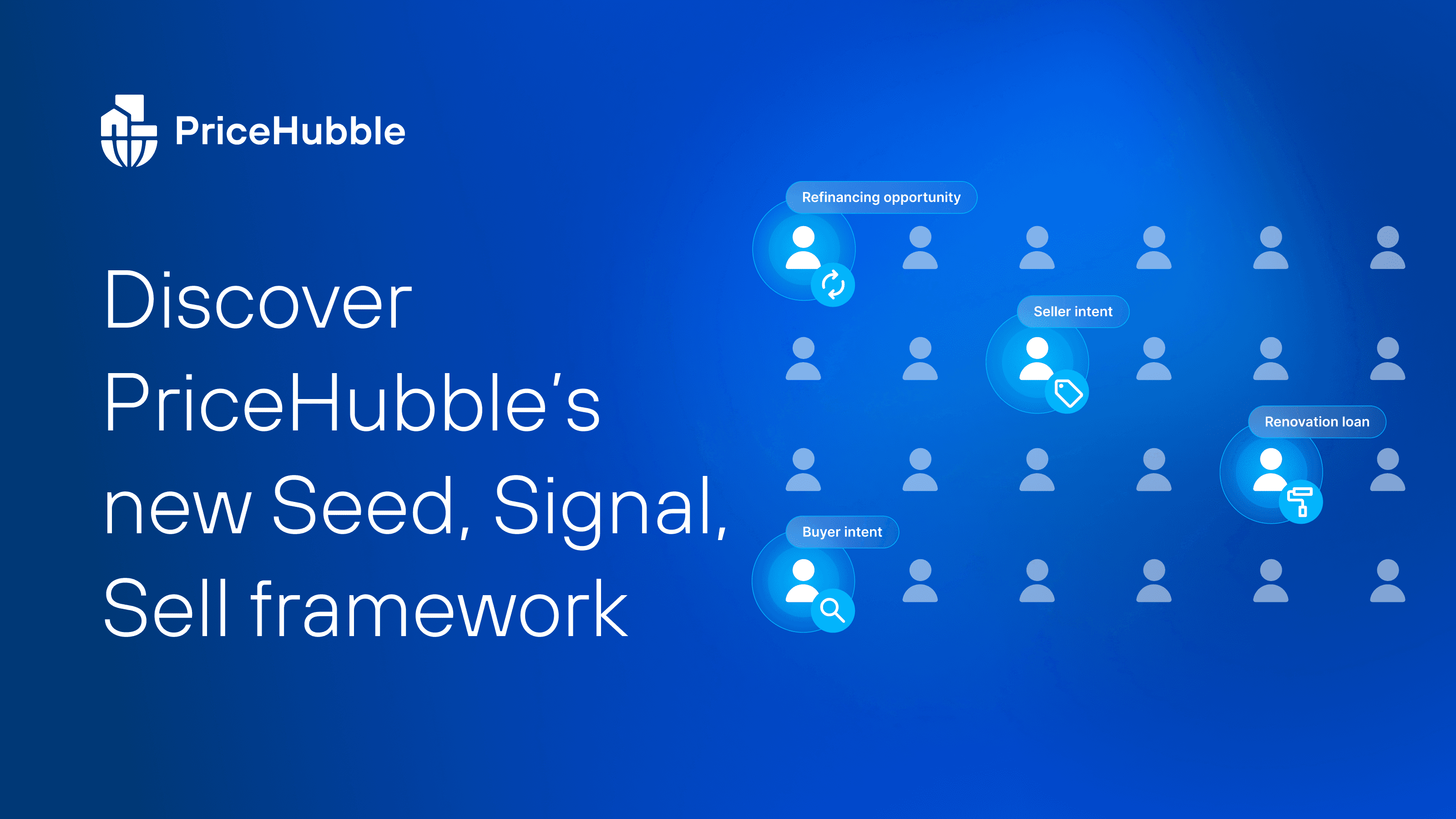
Each of these events is a signal. For a mortgage lender, a client whose property has appreciated significantly may have crossed into a refinancing opportunity they are not yet aware of. For a wealth manager, a property crossing a significant value threshold may open a planning conversation that is overdue. For a real estate agency, behavioural data showing a homeowner repeatedly checking comparable sales and browsing listings in a new area is a strong indicator of seller intent, weeks before they make contact.
The problem is that these signals have historically been invisible to the businesses that need them. Property data exists across public registers, listing portals, and market databases, but it has never been connected to the customer records in a CRM. The signal is there. The infrastructure to read it has not been.
Seed, Signal, Sell is built on that infrastructure.
How the framework works
Seed: build the relationship that generates the signal
The Seed stage is about creating a continuous, meaningful presence in a property owner's life before they have an active need. In practice, this means giving customers access to a branded property experience: a portal or app where they can monitor their property value, track local market trends, view comparable sales, and explore what their property could be worth under different scenarios.
This serves two purposes. For the customer, it is genuinely useful. For the business, every interaction generates behavioural data: how often someone checks their valuation, whether they have opened a refinancing or selling simulator, whether they have started browsing properties in a different area. This data, layered on top of property market intelligence and existing CRM records, is what makes the Signal stage possible.
The Seed stage also works for net new pipeline. Property owners who have no existing relationship with a business can discover the branded property experience, engage with it, and enter the contact base as warm leads, already signalling intent through their behaviour, without ever filling in an enquiry form.
Signal: detect the combinations that indicate real intent
The Signal stage is where property data, customer data, and behavioural data are brought together and monitored continuously. The system is looking for combinations of signals rather than individual events, because a single data point rarely tells the full story.
For a mortgage lender: a client with a long-standing relationship, no new mortgage on record, a property at a value peak, and a recent surge in valuation checks is almost certainly preparing to move. That combination scores as a high-priority new purchase mortgage opportunity.
For a wealth manager: a client whose property has appreciated significantly, combined with their age and life stage and no recent portfolio review on record, is a candidate for a proactive wealth planning conversation. The property event opens the door.
For a real estate agency: a homeowner who has checked their valuation multiple times, viewed comparable sales, and started browsing listings in another area is a prospective seller. The agency that identifies this first and reaches out with relevant, timely information is the one most likely to win the instruction.
The Signal stage does not require advisors to monitor individual records. The system runs continuously, scores every relevant combination, and routes opportunities to the right action automatically.
Sell: convert the signal into a conversation
When a high-priority signal fires, the system determines the most appropriate next action: an automated personalised outreach triggered by the data event, an AI-assisted call, or an alert to a human advisor with full context already prepared. The advisor does not start from cold. They start knowing what has changed in the customer's property situation, what the signal indicates, and what conversation is likely to land.
If the timing is not yet right, the system continues nurturing and re-engages automatically when conditions change.

What Seed, Signal, Sell is not
It is not a marketing automation platform. The framework is built on property intelligence, not campaign logic. Outreach is triggered by real-world data events, not by calendar sequences or demographic segments.
It is not a lead scoring tool. Lead scoring typically operates on static data. Seed, Signal, Sell monitors dynamic property and behavioural signals continuously, which means the opportunity score for any given contact changes as their circumstances change.
It is not a CRM replacement. It works alongside existing CRM infrastructure, enriching it with property data and behavioural signals that the CRM cannot capture on its own.
Why this matters now
Two trends are converging to make property signal intelligence a competitive necessity rather than a nice-to-have.
The first is the rising cost of generic outreach. Email open rates are falling. Paid acquisition costs are rising. Customers are less responsive to communications that do not feel relevant to their specific situation. The businesses that are maintaining strong conversion rates are doing so by reaching fewer people, more precisely, at moments of genuine intent.
The second is the increasing availability of property data. Public registers, listing portals, and planning systems are generating more structured, accessible data than at any previous point. The businesses that build the capability to read this data and connect it to their customer relationships are creating an advantage that compounds over time.
Seed, Signal, Sell is the framework that connects these two realities: the need for precise, timely commercial conversations, and the availability of property signal data that makes them possible.
Who is using it
PriceHubble works with mortgage lenders, wealth managers, real estate agencies, insurance providers, and utility companies across Europe. The framework applies wherever a business has a relationship to a property owner and a commercial interest in knowing when that property owner's situation is changing.
The signals vary by sector. The underlying logic does not.
PriceHubble provides property intelligence and the Seed, Signal, Sell growth engine for real estate and finance businesses across Europe. Get in touch to see what it looks like on your contact base.
Every business with a relationship to a property owner is sitting on a pipeline problem they have not yet named. The customers who leave do not announce it. The prospects who are ready to buy do not raise their hands. The signals that would have prompted the right conversation at the right moment exist in the data. They just go unread.
Seed, Signal, Sell is the property intelligence framework built to fix that.
What is Seed, Signal, Sell?
Seed, Signal, Sell is a property intelligence framework developed by PriceHubble that enables real estate and finance businesses to identify commercial opportunities in their contact base before those opportunities become visible to competitors, or disappear entirely.
The framework operates as a continuous growth engine across three stages: seeding relationships that generate behavioural data, detecting signals that indicate intent, and converting those signals into timely, relevant commercial conversations.
It is used by mortgage lenders, wealth managers, real estate agencies, insurance providers, and utilities, any business where a customer's property is connected to their financial decisions and life events.
Why property is the most underused signal in real estate and finance
Property is the largest asset most people will ever own. It drives borrowing decisions, wealth planning, insurance requirements, renovation spending, and relocation behaviour. It is also an asset that generates continuous, observable activity: valuations shift, listings go live, comparable sales happen nearby, planning applications are submitted.
Each of these events is a signal. For a mortgage lender, a client whose property has appreciated significantly may have crossed into a refinancing opportunity they are not yet aware of. For a wealth manager, a property crossing a significant value threshold may open a planning conversation that is overdue. For a real estate agency, behavioural data showing a homeowner repeatedly checking comparable sales and browsing listings in a new area is a strong indicator of seller intent, weeks before they make contact.
The problem is that these signals have historically been invisible to the businesses that need them. Property data exists across public registers, listing portals, and market databases, but it has never been connected to the customer records in a CRM. The signal is there. The infrastructure to read it has not been.
Seed, Signal, Sell is built on that infrastructure.
How the framework works
Seed: build the relationship that generates the signal
The Seed stage is about creating a continuous, meaningful presence in a property owner's life before they have an active need. In practice, this means giving customers access to a branded property experience: a portal or app where they can monitor their property value, track local market trends, view comparable sales, and explore what their property could be worth under different scenarios.
This serves two purposes. For the customer, it is genuinely useful. For the business, every interaction generates behavioural data: how often someone checks their valuation, whether they have opened a refinancing or selling simulator, whether they have started browsing properties in a different area. This data, layered on top of property market intelligence and existing CRM records, is what makes the Signal stage possible.
The Seed stage also works for net new pipeline. Property owners who have no existing relationship with a business can discover the branded property experience, engage with it, and enter the contact base as warm leads, already signalling intent through their behaviour, without ever filling in an enquiry form.
Signal: detect the combinations that indicate real intent
The Signal stage is where property data, customer data, and behavioural data are brought together and monitored continuously. The system is looking for combinations of signals rather than individual events, because a single data point rarely tells the full story.
For a mortgage lender: a client with a long-standing relationship, no new mortgage on record, a property at a value peak, and a recent surge in valuation checks is almost certainly preparing to move. That combination scores as a high-priority new purchase mortgage opportunity.
For a wealth manager: a client whose property has appreciated significantly, combined with their age and life stage and no recent portfolio review on record, is a candidate for a proactive wealth planning conversation. The property event opens the door.
For a real estate agency: a homeowner who has checked their valuation multiple times, viewed comparable sales, and started browsing listings in another area is a prospective seller. The agency that identifies this first and reaches out with relevant, timely information is the one most likely to win the instruction.
The Signal stage does not require advisors to monitor individual records. The system runs continuously, scores every relevant combination, and routes opportunities to the right action automatically.
Sell: convert the signal into a conversation
When a high-priority signal fires, the system determines the most appropriate next action: an automated personalised outreach triggered by the data event, an AI-assisted call, or an alert to a human advisor with full context already prepared. The advisor does not start from cold. They start knowing what has changed in the customer's property situation, what the signal indicates, and what conversation is likely to land.
If the timing is not yet right, the system continues nurturing and re-engages automatically when conditions change.
What Seed, Signal, Sell is not
It is not a marketing automation platform. The framework is built on property intelligence, not campaign logic. Outreach is triggered by real-world data events, not by calendar sequences or demographic segments.
It is not a lead scoring tool. Lead scoring typically operates on static data. Seed, Signal, Sell monitors dynamic property and behavioural signals continuously, which means the opportunity score for any given contact changes as their circumstances change.
It is not a CRM replacement. It works alongside existing CRM infrastructure, enriching it with property data and behavioural signals that the CRM cannot capture on its own.
Why this matters now
Two trends are converging to make property signal intelligence a competitive necessity rather than a nice-to-have.
The first is the rising cost of generic outreach. Email open rates are falling. Paid acquisition costs are rising. Customers are less responsive to communications that do not feel relevant to their specific situation. The businesses that are maintaining strong conversion rates are doing so by reaching fewer people, more precisely, at moments of genuine intent.
The second is the increasing availability of property data. Public registers, listing portals, and planning systems are generating more structured, accessible data than at any previous point. The businesses that build the capability to read this data and connect it to their customer relationships are creating an advantage that compounds over time.
Seed, Signal, Sell is the framework that connects these two realities: the need for precise, timely commercial conversations, and the availability of property signal data that makes them possible.
Who is using it
PriceHubble works with mortgage lenders, wealth managers, real estate agencies, insurance providers, and utility companies across Europe. The framework applies wherever a business has a relationship to a property owner and a commercial interest in knowing when that property owner's situation is changing.
The signals vary by sector. The underlying logic does not.
PriceHubble provides property intelligence and the Seed, Signal, Sell growth engine for real estate and finance businesses across Europe. Get in touch to see what it looks like on your contact base.
Every business with a relationship to a property owner is sitting on a pipeline problem they have not yet named. The customers who leave do not announce it. The prospects who are ready to buy do not raise their hands. The signals that would have prompted the right conversation at the right moment exist in the data. They just go unread.
Seed, Signal, Sell is the property intelligence framework built to fix that.
What is Seed, Signal, Sell?
Seed, Signal, Sell is a property intelligence framework developed by PriceHubble that enables real estate and finance businesses to identify commercial opportunities in their contact base before those opportunities become visible to competitors, or disappear entirely.
The framework operates as a continuous growth engine across three stages: seeding relationships that generate behavioural data, detecting signals that indicate intent, and converting those signals into timely, relevant commercial conversations.
It is used by mortgage lenders, wealth managers, real estate agencies, insurance providers, and utilities, any business where a customer's property is connected to their financial decisions and life events.
Why property is the most underused signal in real estate and finance
Property is the largest asset most people will ever own. It drives borrowing decisions, wealth planning, insurance requirements, renovation spending, and relocation behaviour. It is also an asset that generates continuous, observable activity: valuations shift, listings go live, comparable sales happen nearby, planning applications are submitted.
Each of these events is a signal. For a mortgage lender, a client whose property has appreciated significantly may have crossed into a refinancing opportunity they are not yet aware of. For a wealth manager, a property crossing a significant value threshold may open a planning conversation that is overdue. For a real estate agency, behavioural data showing a homeowner repeatedly checking comparable sales and browsing listings in a new area is a strong indicator of seller intent, weeks before they make contact.
The problem is that these signals have historically been invisible to the businesses that need them. Property data exists across public registers, listing portals, and market databases, but it has never been connected to the customer records in a CRM. The signal is there. The infrastructure to read it has not been.
Seed, Signal, Sell is built on that infrastructure.
How the framework works
Seed: build the relationship that generates the signal
The Seed stage is about creating a continuous, meaningful presence in a property owner's life before they have an active need. In practice, this means giving customers access to a branded property experience: a portal or app where they can monitor their property value, track local market trends, view comparable sales, and explore what their property could be worth under different scenarios.
This serves two purposes. For the customer, it is genuinely useful. For the business, every interaction generates behavioural data: how often someone checks their valuation, whether they have opened a refinancing or selling simulator, whether they have started browsing properties in a different area. This data, layered on top of property market intelligence and existing CRM records, is what makes the Signal stage possible.
The Seed stage also works for net new pipeline. Property owners who have no existing relationship with a business can discover the branded property experience, engage with it, and enter the contact base as warm leads, already signalling intent through their behaviour, without ever filling in an enquiry form.
Signal: detect the combinations that indicate real intent
The Signal stage is where property data, customer data, and behavioural data are brought together and monitored continuously. The system is looking for combinations of signals rather than individual events, because a single data point rarely tells the full story.
For a mortgage lender: a client with a long-standing relationship, no new mortgage on record, a property at a value peak, and a recent surge in valuation checks is almost certainly preparing to move. That combination scores as a high-priority new purchase mortgage opportunity.
For a wealth manager: a client whose property has appreciated significantly, combined with their age and life stage and no recent portfolio review on record, is a candidate for a proactive wealth planning conversation. The property event opens the door.
For a real estate agency: a homeowner who has checked their valuation multiple times, viewed comparable sales, and started browsing listings in another area is a prospective seller. The agency that identifies this first and reaches out with relevant, timely information is the one most likely to win the instruction.
The Signal stage does not require advisors to monitor individual records. The system runs continuously, scores every relevant combination, and routes opportunities to the right action automatically.
Sell: convert the signal into a conversation
When a high-priority signal fires, the system determines the most appropriate next action: an automated personalised outreach triggered by the data event, an AI-assisted call, or an alert to a human advisor with full context already prepared. The advisor does not start from cold. They start knowing what has changed in the customer's property situation, what the signal indicates, and what conversation is likely to land.
If the timing is not yet right, the system continues nurturing and re-engages automatically when conditions change.
What Seed, Signal, Sell is not
It is not a marketing automation platform. The framework is built on property intelligence, not campaign logic. Outreach is triggered by real-world data events, not by calendar sequences or demographic segments.
It is not a lead scoring tool. Lead scoring typically operates on static data. Seed, Signal, Sell monitors dynamic property and behavioural signals continuously, which means the opportunity score for any given contact changes as their circumstances change.
It is not a CRM replacement. It works alongside existing CRM infrastructure, enriching it with property data and behavioural signals that the CRM cannot capture on its own.
Why this matters now
Two trends are converging to make property signal intelligence a competitive necessity rather than a nice-to-have.
The first is the rising cost of generic outreach. Email open rates are falling. Paid acquisition costs are rising. Customers are less responsive to communications that do not feel relevant to their specific situation. The businesses that are maintaining strong conversion rates are doing so by reaching fewer people, more precisely, at moments of genuine intent.
The second is the increasing availability of property data. Public registers, listing portals, and planning systems are generating more structured, accessible data than at any previous point. The businesses that build the capability to read this data and connect it to their customer relationships are creating an advantage that compounds over time.
Seed, Signal, Sell is the framework that connects these two realities: the need for precise, timely commercial conversations, and the availability of property signal data that makes them possible.
Who is using it
PriceHubble works with mortgage lenders, wealth managers, real estate agencies, insurance providers, and utility companies across Europe. The framework applies wherever a business has a relationship to a property owner and a commercial interest in knowing when that property owner's situation is changing.
The signals vary by sector. The underlying logic does not.
PriceHubble provides property intelligence and the Seed, Signal, Sell growth engine for real estate and finance businesses across Europe. Get in touch to see what it looks like on your contact base.
Request a demo
We will get back to you quickly.
We look forward to speaking with you.
Thank you!
We will get back to you within 24 business hours.

Thank you!
We will get back to you within 24 business hours.