How local real estate markets create growth opportunities for banks: 4 examples
Best Practices & Trends
Published by
Vinzenz Ager
-
May 30, 2023

How local real estate markets create growth opportunities for banks: 4 examples
Best Practices & Trends
Published by
Vinzenz Ager
-
May 30, 2023
How local real estate markets create growth opportunities for banks: 4 examples
Best Practices & Trends
Published by
Vinzenz Ager
-
May 30, 2023
Customer centricity, personalised experiences and meaningful relationships are key factors in the success of banks and financial service providers. It is also evident that local real estate is the perfect anchor point for banks and financial service providers to get closer to their customers, due to it being a particularly emotional asset class. Besides these few ‘global’ arguments, it is important to examine the market situation in a few countries in order to understand how real estate data can benefit banks, and financial service providers on a local level. In our article, we focus on the market situation in the UK, Germany, Switzerland, and France.
Customer centricity, personalised experiences and meaningful relationships are key factors in the success of banks and financial service providers. It is also evident that local real estate is the perfect anchor point for banks and financial service providers to get closer to their customers, due to it being a particularly emotional asset class. Besides these few ‘global’ arguments, it is important to examine the market situation in a few countries in order to understand how real estate data can benefit banks, and financial service providers on a local level. In our article, we focus on the market situation in the UK, Germany, Switzerland, and France.
Customer centricity, personalised experiences and meaningful relationships are key factors in the success of banks and financial service providers. It is also evident that local real estate is the perfect anchor point for banks and financial service providers to get closer to their customers, due to it being a particularly emotional asset class. Besides these few ‘global’ arguments, it is important to examine the market situation in a few countries in order to understand how real estate data can benefit banks, and financial service providers on a local level. In our article, we focus on the market situation in the UK, Germany, Switzerland, and France.
Ebooks & WHITEPAPERS
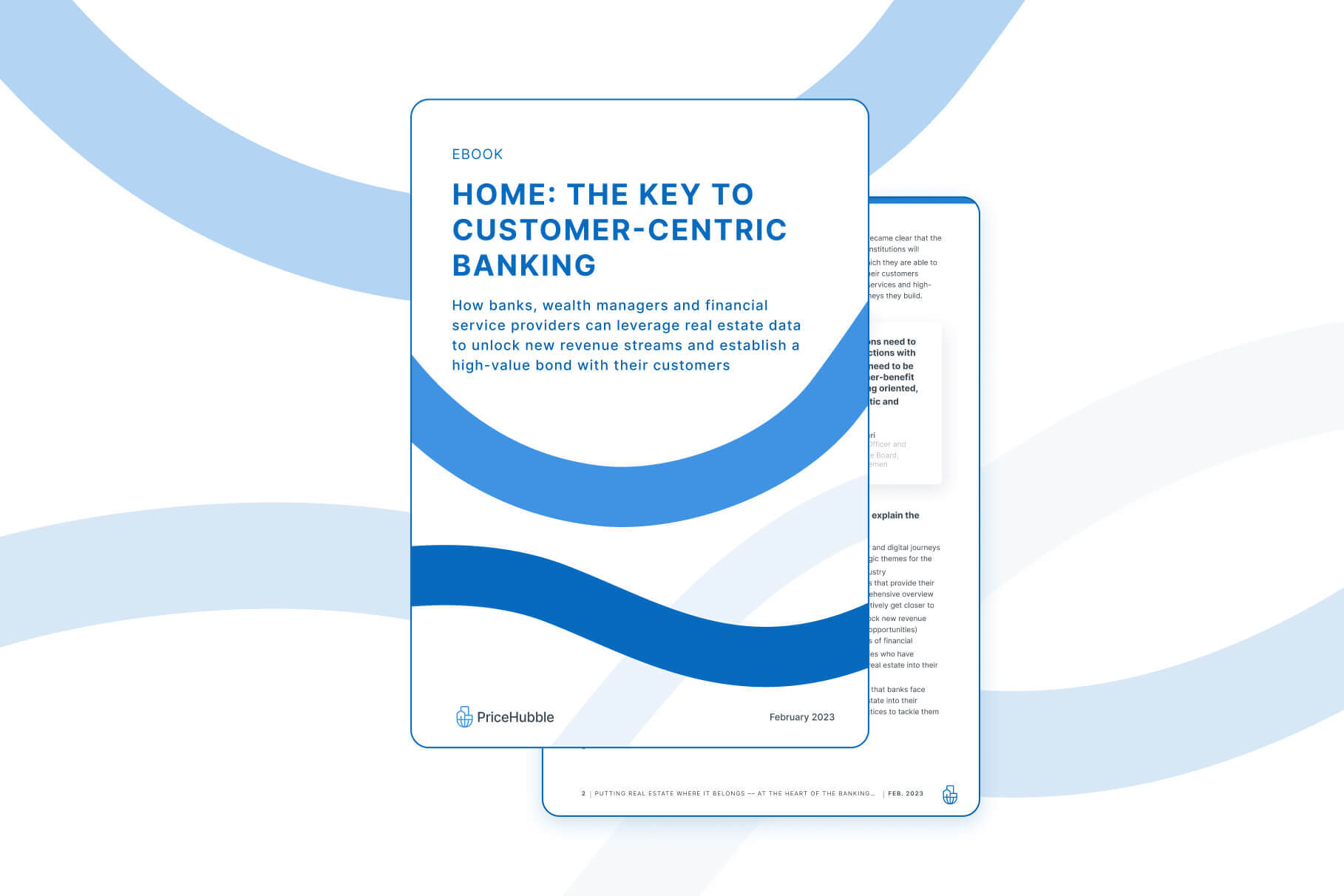
Home: The key to customer-centric banking
Ebooks & WHITEPAPERS
Home: The key to customer-centric banking
Local real estate in the United Kingdom: Managing property as an asset
With rising interest rates, growing prices per square feet, complex ESG matters coming to the fore and evolving demographics–– being able to manage residential properties as assets is important for the UK consumer.
This is particularly the case when considering the following market trends:
The dynamic real estate market (buy-to-let, asset value management, ownership structures and shared appreciation with the government for first-time buyers) –– this should be considered alongside changing demographics. “It creates challenges for first-time buyers to access the housing market due to high home prices and raises the question of how they can connect their savings to a housing project”, explains PriceHubble advisor Tony Prestedge.
The high proportion of buy-to-let landlords for whom it is crucial to have a precise and holistic overview of their properties as assets. As they invest in residential realty, they need to ensure ESG compliance and seek to maximise home value and yield.
The demand for home buying outstrips the number of homes for sale across the country. “In such a situation, the individual value of your home becomes much more material in the context of your overall wealth”, says Tony Prestedge.
Yet, banking institutions in the UK and the EU have traditionally separated properties from other investments explains Tony Prestedge, he also goes on to say: “Today, if I open my banking app, my dashboards show me how much I owe but not how much my property is worth, nor its ESG rating, nor an overview of the latest developments in my area.”
Local real estate in the United Kingdom: Managing property as an asset
With rising interest rates, growing prices per square feet, complex ESG matters coming to the fore and evolving demographics–– being able to manage residential properties as assets is important for the UK consumer.
This is particularly the case when considering the following market trends:
The dynamic real estate market (buy-to-let, asset value management, ownership structures and shared appreciation with the government for first-time buyers) –– this should be considered alongside changing demographics. “It creates challenges for first-time buyers to access the housing market due to high home prices and raises the question of how they can connect their savings to a housing project”, explains PriceHubble advisor Tony Prestedge.
The high proportion of buy-to-let landlords for whom it is crucial to have a precise and holistic overview of their properties as assets. As they invest in residential realty, they need to ensure ESG compliance and seek to maximise home value and yield.
The demand for home buying outstrips the number of homes for sale across the country. “In such a situation, the individual value of your home becomes much more material in the context of your overall wealth”, says Tony Prestedge.
Yet, banking institutions in the UK and the EU have traditionally separated properties from other investments explains Tony Prestedge, he also goes on to say: “Today, if I open my banking app, my dashboards show me how much I owe but not how much my property is worth, nor its ESG rating, nor an overview of the latest developments in my area.”
Local real estate in the United Kingdom: Managing property as an asset
With rising interest rates, growing prices per square feet, complex ESG matters coming to the fore and evolving demographics–– being able to manage residential properties as assets is important for the UK consumer.
This is particularly the case when considering the following market trends:
The dynamic real estate market (buy-to-let, asset value management, ownership structures and shared appreciation with the government for first-time buyers) –– this should be considered alongside changing demographics. “It creates challenges for first-time buyers to access the housing market due to high home prices and raises the question of how they can connect their savings to a housing project”, explains PriceHubble advisor Tony Prestedge.
The high proportion of buy-to-let landlords for whom it is crucial to have a precise and holistic overview of their properties as assets. As they invest in residential realty, they need to ensure ESG compliance and seek to maximise home value and yield.
The demand for home buying outstrips the number of homes for sale across the country. “In such a situation, the individual value of your home becomes much more material in the context of your overall wealth”, says Tony Prestedge.
Yet, banking institutions in the UK and the EU have traditionally separated properties from other investments explains Tony Prestedge, he also goes on to say: “Today, if I open my banking app, my dashboards show me how much I owe but not how much my property is worth, nor its ESG rating, nor an overview of the latest developments in my area.”
But the situation is evolving: “Consumers started to really want a 360 view of their property. That’s where digital disruption is happening”, Tony Prestedge says. “In a market where retail banks, brokers, real estate professionals and local real estate agents will have to fight much harder to find and retain customers, it becomes crucial to be able to use data to gamify the relationship, make it more interactive.”
Germany: Breaking the barriers to homeownership and digital transformation
When delving into the real estate market situation in Germany, two key elements stand out:
First, German consumers lack access to homeownership –– approximately only half the population owns the home they live in –– this puts financial institutions under pressure. “Financial service providers have to deal with a low rate of homeownership, and this –– combined with the current economic situation, multiple crises and rising interest rates –– certainly does not help reverse this trend”, says André Boldt, Head of Baloise Germany’s Housing Department. Fewer consumers purchasing loans means that German institutions face increased competition as well as pressure to retain existing customers, expand business with them and to attract new customers.
But the situation is evolving: “Consumers started to really want a 360 view of their property. That’s where digital disruption is happening”, Tony Prestedge says. “In a market where retail banks, brokers, real estate professionals and local real estate agents will have to fight much harder to find and retain customers, it becomes crucial to be able to use data to gamify the relationship, make it more interactive.”
Germany: Breaking the barriers to homeownership and digital transformation
When delving into the real estate market situation in Germany, two key elements stand out:
First, German consumers lack access to homeownership –– approximately only half the population owns the home they live in –– this puts financial institutions under pressure. “Financial service providers have to deal with a low rate of homeownership, and this –– combined with the current economic situation, multiple crises and rising interest rates –– certainly does not help reverse this trend”, says André Boldt, Head of Baloise Germany’s Housing Department. Fewer consumers purchasing loans means that German institutions face increased competition as well as pressure to retain existing customers, expand business with them and to attract new customers.
But the situation is evolving: “Consumers started to really want a 360 view of their property. That’s where digital disruption is happening”, Tony Prestedge says. “In a market where retail banks, brokers, real estate professionals and local real estate agents will have to fight much harder to find and retain customers, it becomes crucial to be able to use data to gamify the relationship, make it more interactive.”
Germany: Breaking the barriers to homeownership and digital transformation
When delving into the real estate market situation in Germany, two key elements stand out:
First, German consumers lack access to homeownership –– approximately only half the population owns the home they live in –– this puts financial institutions under pressure. “Financial service providers have to deal with a low rate of homeownership, and this –– combined with the current economic situation, multiple crises and rising interest rates –– certainly does not help reverse this trend”, says André Boldt, Head of Baloise Germany’s Housing Department. Fewer consumers purchasing loans means that German institutions face increased competition as well as pressure to retain existing customers, expand business with them and to attract new customers.
“In the face of numerous crises, rising interest rates and an uncertain economic outlook, bank profitability will remain under pressure.”
Dr. Hansjörg Leichsenring, Der Bank Blog
“In the face of numerous crises, rising interest rates and an uncertain economic outlook, bank profitability will remain under pressure.”
Dr. Hansjörg Leichsenring, Der Bank Blog
“In the face of numerous crises, rising interest rates and an uncertain economic outlook, bank profitability will remain under pressure.”
Dr. Hansjörg Leichsenring, Der Bank Blog
Second, German financial institutions still have progress to make when it comes to digitalising their services. “We see a huge shift in customer expectations in Germany –– consumers demand that their financial institutions be more digital than they are already, even the older generations”, explains Markus Bofinger, Manager of Baloise Germany’s Housing Department. Jörg Agartz, Chief Innovation Officer at Baloise Germany, adds that “the technology and the possibilities are there, but German financial service providers have to catch up when it comes to the practical implementation of such improvements” compared to other countries such as the Netherlands, Denmark, Finland or the UK.
Dr. Hansjörg Leichsenring, owner of the Bank Blog and experienced executive in the banking industry, predicts that the digital transformation of German banks and insurance companies –– already greatly accelerated by the pandemic –– will intensify in the coming years, but warns: “German banks need to keep in mind that digitalisation should not be at the expense of personal support and human advisory.”
Second, German financial institutions still have progress to make when it comes to digitalising their services. “We see a huge shift in customer expectations in Germany –– consumers demand that their financial institutions be more digital than they are already, even the older generations”, explains Markus Bofinger, Manager of Baloise Germany’s Housing Department. Jörg Agartz, Chief Innovation Officer at Baloise Germany, adds that “the technology and the possibilities are there, but German financial service providers have to catch up when it comes to the practical implementation of such improvements” compared to other countries such as the Netherlands, Denmark, Finland or the UK.
Dr. Hansjörg Leichsenring, owner of the Bank Blog and experienced executive in the banking industry, predicts that the digital transformation of German banks and insurance companies –– already greatly accelerated by the pandemic –– will intensify in the coming years, but warns: “German banks need to keep in mind that digitalisation should not be at the expense of personal support and human advisory.”
Second, German financial institutions still have progress to make when it comes to digitalising their services. “We see a huge shift in customer expectations in Germany –– consumers demand that their financial institutions be more digital than they are already, even the older generations”, explains Markus Bofinger, Manager of Baloise Germany’s Housing Department. Jörg Agartz, Chief Innovation Officer at Baloise Germany, adds that “the technology and the possibilities are there, but German financial service providers have to catch up when it comes to the practical implementation of such improvements” compared to other countries such as the Netherlands, Denmark, Finland or the UK.
Dr. Hansjörg Leichsenring, owner of the Bank Blog and experienced executive in the banking industry, predicts that the digital transformation of German banks and insurance companies –– already greatly accelerated by the pandemic –– will intensify in the coming years, but warns: “German banks need to keep in mind that digitalisation should not be at the expense of personal support and human advisory.”
“Banking customers are now able to get advice from anywhere, at any moment. And, this flexibility will likely increase even more in the future.”
Frank Jökel, Senior Consultant, MLP Finanzberatung SE
“Banking customers are now able to get advice from anywhere, at any moment. And, this flexibility will likely increase even more in the future.”
Frank Jökel, Senior Consultant, MLP Finanzberatung SE
“Banking customers are now able to get advice from anywhere, at any moment. And, this flexibility will likely increase even more in the future.”
Frank Jökel, Senior Consultant, MLP Finanzberatung SE
This unique situation –– increasing competition and rising customer expectations combined with a need for more digitalisation –– creates both a challenge and an opportunity for the banking industry, as it needs to diversify and digitally transform its services to ensure business continuity.
Yet, in this competitive and volatile environment, real estate appears to be an excellent opportunity for these institutions to develop novel digital services that are close to their customers’ hearts, thereby acquiring and retaining them more efficiently. Juri Kaiser, Director of Sales at BSK Immobilien, explains: “This is a very exciting field, as banking institutions will manage to build up digital customer journeys in such a way that customers will get access to financial advice and services that go way beyond the usual banking transactions”.
Switzerland: Accompanying customers along the real estate lifecycle
When asked about the Swiss market, Prof. Dr. Andreas Dietrich, Professor for Banking and Finance at the Lucerne University of Applied Sciences and Member of the Board of Directors at the Luzerner Kantonalbank AG, points out a few important characteristics which we go through in more detail below.
First, Swiss banks are usually proactive and helpful when consulting customers at the loan origination stage as they generally provide precise valuations for the properties applied for.
Yet, as housing demand strongly outstrips supply in the Swiss market, most aspiring homeowners attempt to purchase property several times before becoming successful. This represents a communication opportunity for banks; for example, if a customer’s application is unsuccessful, banks could easily keep in touch by sending emails containing offers based on similar criteria to the property (like the same sale price, price range or number of sqft) which their customers did not get to buy.
“It would be a good opportunity for them to recommend similar properties to their customers in an automated way”, Prof. Dr. Andreas Dietrich explains. Unfortunately, most banks do not tap into the potential of failed property applications and therefore miss out on an effective way to engage customers.
What’s more, Prof. Dr. Dietrich considers that Swiss banks could take it one step further by informing customers about their potential savings, e.g. if old heating systems are replaced, windows are renovated, or if energy-related renovations take place especially as this type of renovation is an income tax deductible in Switzerland. “For such topics, Swiss consumers generally need and appreciate being consulted”, he adds.
France: ESG as a key opportunity to provide added value
When discussing specificities of the French market with Gustav Sondén, cofounder and co-CEO of Colbr, an interesting characteristic came up: the fact that homeownership is deeply rooted in French culture ––– with rental investment gaining traction ––– means that more and more French consumers have become owners of their dream home in recent years, taking advantage of low-interest rates.
However, the increase in popularity of homeownership is taking place at the same time as another major event –– stricter ESG-related regulations being implemented (e.g. overhaul of the DPE, or “Loi Climat et Résilience”). “Concretely, this means that many landlords and homeowners find themselves with a property that they may need to renovate very soon”, Gustav Sondén explains. “And the lack of transparency on the situation and on the impact that energy-efficiency factors have on the value of their properties puts them in a tough position”, he adds.
“For consumers, getting data on the impact of energy performance on the value of their homes will become crucial. And thus, providing transparency on that topic will become a key challenge for French institutions”, Gustav Sondén concludes.
This means, French institutions have an unparalleled opportunity to provide customers with the information they need at the exact right time and support them with adequate funding for renovation works. Further to this, banks that plan to integrate this information into their existing digital environments should not face much resistance ––– in fact, Gustav Sondén notes that French consumers, especially younger generations, are tech-savvy and have drastically changed their digital and content consumption habits. “It’s actually impressive to see how fast they adopt new products and interfaces”, he notes.
Local real estate opportunities for banks are driven by the national market situation
In conclusion, local real estate presents a significant opportunity for financial institutions to diversify their services and establish deeper relationships with their customers. By leveraging real estate data, banks, wealth managers, and financial service providers can offer personalised experiences and create a high-value bond with their clients. However, it's also important to note that local differences in real estate markets can greatly impact the strategies and approaches that financial institutions should take, as we have seen on the exemplary analysed countries. For a more in-depth look at how financial institutions can use real estate data to their advantage, download our ebook below:
This unique situation –– increasing competition and rising customer expectations combined with a need for more digitalisation –– creates both a challenge and an opportunity for the banking industry, as it needs to diversify and digitally transform its services to ensure business continuity.
Yet, in this competitive and volatile environment, real estate appears to be an excellent opportunity for these institutions to develop novel digital services that are close to their customers’ hearts, thereby acquiring and retaining them more efficiently. Juri Kaiser, Director of Sales at BSK Immobilien, explains: “This is a very exciting field, as banking institutions will manage to build up digital customer journeys in such a way that customers will get access to financial advice and services that go way beyond the usual banking transactions”.
Switzerland: Accompanying customers along the real estate lifecycle
When asked about the Swiss market, Prof. Dr. Andreas Dietrich, Professor for Banking and Finance at the Lucerne University of Applied Sciences and Member of the Board of Directors at the Luzerner Kantonalbank AG, points out a few important characteristics which we go through in more detail below.
First, Swiss banks are usually proactive and helpful when consulting customers at the loan origination stage as they generally provide precise valuations for the properties applied for.
Yet, as housing demand strongly outstrips supply in the Swiss market, most aspiring homeowners attempt to purchase property several times before becoming successful. This represents a communication opportunity for banks; for example, if a customer’s application is unsuccessful, banks could easily keep in touch by sending emails containing offers based on similar criteria to the property (like the same sale price, price range or number of sqft) which their customers did not get to buy.
“It would be a good opportunity for them to recommend similar properties to their customers in an automated way”, Prof. Dr. Andreas Dietrich explains. Unfortunately, most banks do not tap into the potential of failed property applications and therefore miss out on an effective way to engage customers.
What’s more, Prof. Dr. Dietrich considers that Swiss banks could take it one step further by informing customers about their potential savings, e.g. if old heating systems are replaced, windows are renovated, or if energy-related renovations take place especially as this type of renovation is an income tax deductible in Switzerland. “For such topics, Swiss consumers generally need and appreciate being consulted”, he adds.
France: ESG as a key opportunity to provide added value
When discussing specificities of the French market with Gustav Sondén, cofounder and co-CEO of Colbr, an interesting characteristic came up: the fact that homeownership is deeply rooted in French culture ––– with rental investment gaining traction ––– means that more and more French consumers have become owners of their dream home in recent years, taking advantage of low-interest rates.
However, the increase in popularity of homeownership is taking place at the same time as another major event –– stricter ESG-related regulations being implemented (e.g. overhaul of the DPE, or “Loi Climat et Résilience”). “Concretely, this means that many landlords and homeowners find themselves with a property that they may need to renovate very soon”, Gustav Sondén explains. “And the lack of transparency on the situation and on the impact that energy-efficiency factors have on the value of their properties puts them in a tough position”, he adds.
“For consumers, getting data on the impact of energy performance on the value of their homes will become crucial. And thus, providing transparency on that topic will become a key challenge for French institutions”, Gustav Sondén concludes.
This means, French institutions have an unparalleled opportunity to provide customers with the information they need at the exact right time and support them with adequate funding for renovation works. Further to this, banks that plan to integrate this information into their existing digital environments should not face much resistance ––– in fact, Gustav Sondén notes that French consumers, especially younger generations, are tech-savvy and have drastically changed their digital and content consumption habits. “It’s actually impressive to see how fast they adopt new products and interfaces”, he notes.
Local real estate opportunities for banks are driven by the national market situation
In conclusion, local real estate presents a significant opportunity for financial institutions to diversify their services and establish deeper relationships with their customers. By leveraging real estate data, banks, wealth managers, and financial service providers can offer personalised experiences and create a high-value bond with their clients. However, it's also important to note that local differences in real estate markets can greatly impact the strategies and approaches that financial institutions should take, as we have seen on the exemplary analysed countries. For a more in-depth look at how financial institutions can use real estate data to their advantage, download our ebook below:
This unique situation –– increasing competition and rising customer expectations combined with a need for more digitalisation –– creates both a challenge and an opportunity for the banking industry, as it needs to diversify and digitally transform its services to ensure business continuity.
Yet, in this competitive and volatile environment, real estate appears to be an excellent opportunity for these institutions to develop novel digital services that are close to their customers’ hearts, thereby acquiring and retaining them more efficiently. Juri Kaiser, Director of Sales at BSK Immobilien, explains: “This is a very exciting field, as banking institutions will manage to build up digital customer journeys in such a way that customers will get access to financial advice and services that go way beyond the usual banking transactions”.
Switzerland: Accompanying customers along the real estate lifecycle
When asked about the Swiss market, Prof. Dr. Andreas Dietrich, Professor for Banking and Finance at the Lucerne University of Applied Sciences and Member of the Board of Directors at the Luzerner Kantonalbank AG, points out a few important characteristics which we go through in more detail below.
First, Swiss banks are usually proactive and helpful when consulting customers at the loan origination stage as they generally provide precise valuations for the properties applied for.
Yet, as housing demand strongly outstrips supply in the Swiss market, most aspiring homeowners attempt to purchase property several times before becoming successful. This represents a communication opportunity for banks; for example, if a customer’s application is unsuccessful, banks could easily keep in touch by sending emails containing offers based on similar criteria to the property (like the same sale price, price range or number of sqft) which their customers did not get to buy.
“It would be a good opportunity for them to recommend similar properties to their customers in an automated way”, Prof. Dr. Andreas Dietrich explains. Unfortunately, most banks do not tap into the potential of failed property applications and therefore miss out on an effective way to engage customers.
What’s more, Prof. Dr. Dietrich considers that Swiss banks could take it one step further by informing customers about their potential savings, e.g. if old heating systems are replaced, windows are renovated, or if energy-related renovations take place especially as this type of renovation is an income tax deductible in Switzerland. “For such topics, Swiss consumers generally need and appreciate being consulted”, he adds.
France: ESG as a key opportunity to provide added value
When discussing specificities of the French market with Gustav Sondén, cofounder and co-CEO of Colbr, an interesting characteristic came up: the fact that homeownership is deeply rooted in French culture ––– with rental investment gaining traction ––– means that more and more French consumers have become owners of their dream home in recent years, taking advantage of low-interest rates.
However, the increase in popularity of homeownership is taking place at the same time as another major event –– stricter ESG-related regulations being implemented (e.g. overhaul of the DPE, or “Loi Climat et Résilience”). “Concretely, this means that many landlords and homeowners find themselves with a property that they may need to renovate very soon”, Gustav Sondén explains. “And the lack of transparency on the situation and on the impact that energy-efficiency factors have on the value of their properties puts them in a tough position”, he adds.
“For consumers, getting data on the impact of energy performance on the value of their homes will become crucial. And thus, providing transparency on that topic will become a key challenge for French institutions”, Gustav Sondén concludes.
This means, French institutions have an unparalleled opportunity to provide customers with the information they need at the exact right time and support them with adequate funding for renovation works. Further to this, banks that plan to integrate this information into their existing digital environments should not face much resistance ––– in fact, Gustav Sondén notes that French consumers, especially younger generations, are tech-savvy and have drastically changed their digital and content consumption habits. “It’s actually impressive to see how fast they adopt new products and interfaces”, he notes.
Local real estate opportunities for banks are driven by the national market situation
In conclusion, local real estate presents a significant opportunity for financial institutions to diversify their services and establish deeper relationships with their customers. By leveraging real estate data, banks, wealth managers, and financial service providers can offer personalised experiences and create a high-value bond with their clients. However, it's also important to note that local differences in real estate markets can greatly impact the strategies and approaches that financial institutions should take, as we have seen on the exemplary analysed countries. For a more in-depth look at how financial institutions can use real estate data to their advantage, download our ebook below:
See also

News
Read more →

News
Read more →

News
Read more →
Request a demo
We will get back to you quickly.
We look forward to speaking with you.
Thank you!
We will get back to you within 24 business hours.

Thank you!
We will get back to you within 24 business hours.